
America Just Entered The Most Contradictory Phase Of Cannabis Reform Yet
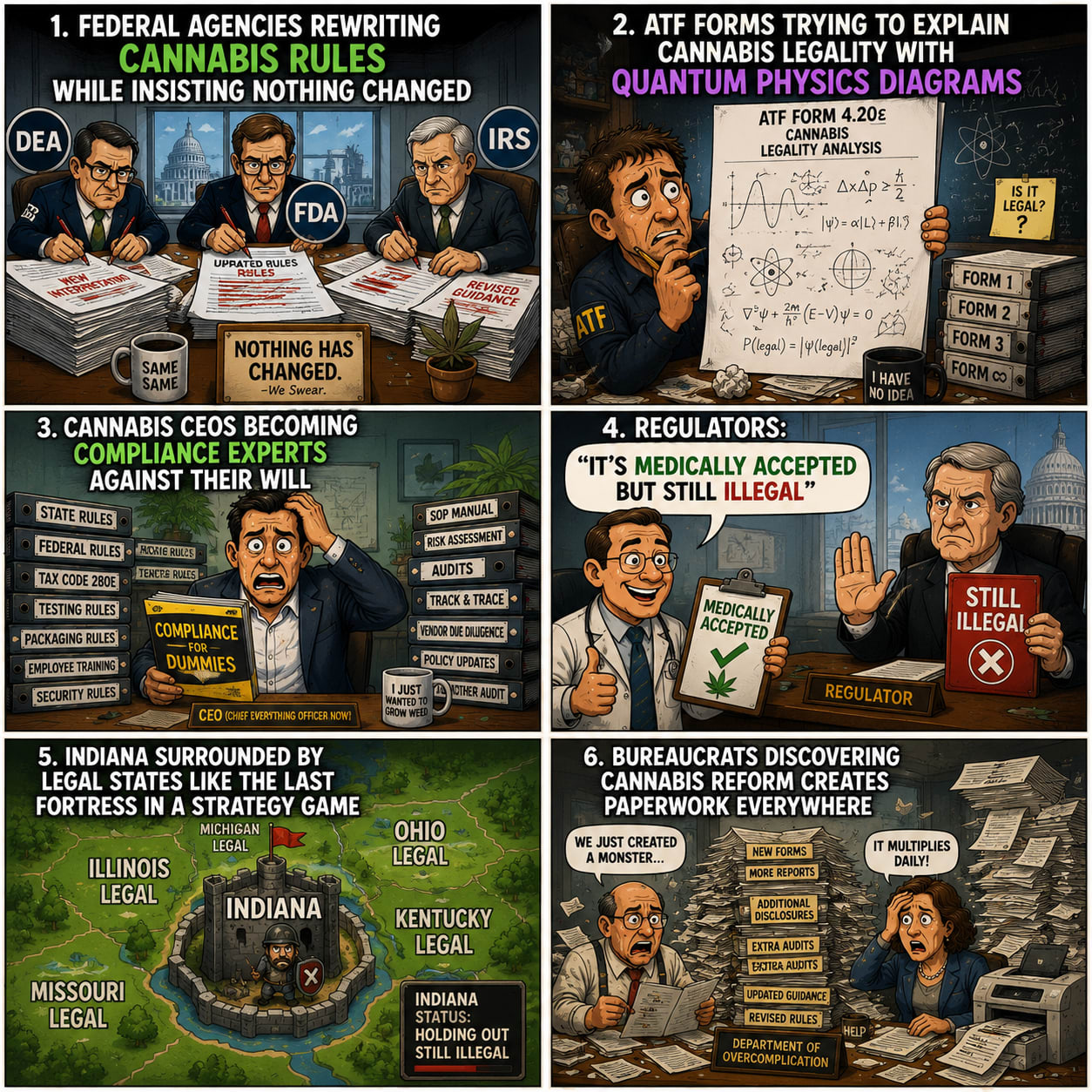
The System Is Adapting In Real Time. And because that transformation is happening unevenly, contradictions are multiplying everywhere.

Cannabis reform is accelerating.
Cannabis enforcement is tightening.
Federal agencies are adapting to legalization.
Federal officials are still insisting marijuana remains illegal.
And somehow… all of those things are true at the same time.
Today’s latest developments from show an industry entering a deeply unstable—but incredibly important—transition phase.
Washington is no longer debating whether cannabis exists.
Now it’s wrestling with something harder:
How do you integrate a federally prohibited substance into mainstream American systems without fully legalizing it?
That contradiction now touches:
Gun laws
Healthcare
Banking
State rights
Federal authority
Corporate retail
Criminal justice
The result is a patchwork system growing more complicated by the week.
But there’s one thing today’s stories make clear:
Cannabis is no longer operating outside the system.
It’s colliding directly with it.
White House Drug Czar Says Cannabis Is “Still Illegal” After Rescheduling
The White House just clarified the most confusing part of modern cannabis policy:
Rescheduling does not mean legalization.
White House Office of National Drug Control Policy Director Sara Carter Bailey emphasized that cannabis remains federally illegal despite the administration’s move to place it in Schedule III.
Her comments reveal the central contradiction driving the entire industry right now.
Cannabis is:
Federally recognized as having medical value
Being integrated into medical systems
Treated more like medicine than narcotics
But simultaneously:
Still criminalized federally
Still heavily restricted
Still politically contested
The administration appears to be attempting something unprecedented:
Normalize medical cannabis while avoiding full legalization.
That balancing act is becoming harder every day.
Because businesses, states and consumers increasingly expect consistency—and Washington keeps producing partial reform instead.
This creates enormous uncertainty around:
Enforcement priorities
Banking access
Federal compliance
Interstate commerce
And politically, it risks frustrating both sides:
Reform advocates who want broader legalization
Opponents who see rescheduling itself as excessive
The White House now finds itself defending a middle ground that may become increasingly difficult to maintain.
Takeaway: Federal cannabis policy is evolving faster than federal cannabis law.
ATF Quietly Changes Gun Form To Reflect Cannabis Rescheduling
One of the most important federal cannabis developments today came from an unlikely place:
Gun paperwork.
The Bureau of Alcohol, Tobacco, Firearms and Explosives proposed updating its firearm purchase form to acknowledge the federally recognized status of medical marijuana under Schedule III.
That may sound technical.
It’s actually massive.
For years, federal gun forms explicitly warned buyers that marijuana remained illegal under federal law—even in medical states.
Now the wording is changing.
That signals something profound:
Federal agencies are beginning to operationalize cannabis reform inside real government systems.
But contradictions remain.
Cannabis users can still face firearm restrictions under federal law.
So the government is effectively acknowledging medical legitimacy while preserving prohibition-era enforcement structures.
That tension is likely headed toward major constitutional battles.
Especially because courts increasingly question whether cannabis users should lose firearm rights at all.
The ATF revision also shows something broader:
Rescheduling is no longer theoretical.
Federal agencies are actively rewriting procedures around it.
That means reform is beginning to move from political announcement → administrative reality.
And once bureaucracy starts changing forms, systems and rules, reform becomes much harder to reverse.
Takeaway: Cannabis reform is quietly being embedded into federal infrastructure.
Pennsylvania Republicans Build Framework For Future Legalization
Pennsylvania may not have legalized recreational cannabis yet.
But lawmakers are increasingly acting like it’s inevitable.
A state Senate committee advanced legislation creating a Cannabis Control Board designed to oversee:
Medical marijuana
Hemp-derived cannabinoids
Future regulatory expansion
And notably, Republican Sen. Dan Laughlin openly acknowledged the structure could prepare Pennsylvania for eventual adult-use legalization.
That matters enormously.
Pennsylvania is one of the largest untapped cannabis markets in America.
And because neighboring states already legalized, Pennsylvania faces growing pressure from:
Lost tax revenue
Cross-border purchasing
Competitive disadvantages
What’s changing now is tone.
The debate is shifting away from:
“Should legalization happen?”
toward:
“How do we regulate it professionally?”
That’s the language of institutional acceptance.
Even more important:
Republicans are increasingly participating in the governance conversation instead of rejecting legalization outright.
That doesn’t guarantee legalization arrives immediately.
But it does suggest the political center of gravity is moving.
Takeaway: Pennsylvania is transitioning from cannabis resistance → cannabis administration.
Oklahoma Warns Cannabis Businesses They Must Register With DEA
Oklahoma regulators issued new guidance warning medical marijuana businesses they must register with the DEA or risk sanctions—including potential loss of state licenses.
This may become one of the clearest examples yet of how federal rescheduling changes operational realities.
For years, state cannabis systems functioned largely outside federal structures.
Now businesses are being pushed toward:
Federal registration
DEA oversight
National compliance systems
That marks a major transformation.
Cannabis operators increasingly face the same reality as pharmaceutical and controlled-substance industries:
Federal recognition comes with federal supervision.
This is likely just the beginning.
As cannabis integrates deeper into federal systems, operators should expect:
More audits
More reporting requirements
More compliance costs
More institutional oversight
The “wild west” era of cannabis appears to be fading quickly.
Takeaway: Cannabis is entering its most regulated era yet.
Minnesota Moves Toward Legal Psilocybin Therapy
Minnesota lawmakers passed an amendment to legalize regulated psilocybin therapy for adults 21 and older.
While technically a psychedelics story, it matters deeply for cannabis because it reflects a broader trend:
America’s drug policy framework is evolving beyond prohibition.
And increasingly, cannabis reform acts as the gateway to broader therapeutic substance reform.
Minnesota’s proposal would create regulated therapeutic access rather than commercial retail legalization.
That distinction matters politically.
Lawmakers increasingly frame these substances through:
Mental health treatment
Medical supervision
Clinical regulation
Instead of recreational freedom.
This healthcare-first framing appears to be gaining bipartisan traction far faster than earlier legalization models.
Cannabis normalized the conversation.
Now psychedelics are following behind it.
Takeaway: Cannabis reform is accelerating broader drug policy transformation across America.
Louisiana Advances Psychedelic Therapy Pilot Program
Louisiana lawmakers approved legislation creating a psychedelic-assisted therapy pilot program funded with opioid settlement money.
The proposal would fund clinical research into:
Psilocybin
MDMA
Ibogaine
As alternatives for addiction and mental health treatment.
The symbolism here is remarkable.
Louisiana is not traditionally viewed as a progressive drug-policy state.
Yet even conservative regions are increasingly willing to explore alternative therapies amid:
Opioid crisis fatigue
Veteran mental health concerns
Treatment shortages
This mirrors the path cannabis followed years earlier:
Medical legitimacy first.
Cultural normalization later.
Takeaway: Psychedelic reform is increasingly following cannabis’s political blueprint.
Indiana Republicans Still Resist Legalization Despite Federal Shift
Indiana remains one of the clearest examples of how divided America still is on cannabis.
Despite growing national momentum and overwhelming public support polls, Republican lawmakers continue pushing back against legalization efforts.
A GOP senator urged Gov. Mike Braun to maintain prohibition despite acknowledging federal rescheduling changes.
This creates a widening regional gap where neighboring legal states increasingly surround prohibition holdouts.
That pressure becomes harder to maintain economically over time.
Especially when:
Residents cross borders to purchase legally
Tax revenue leaves the state
Public support keeps rising
Indiana may resist legalization for now.
But politically, isolation becomes harder each year.
Takeaway: State-level resistance still matters—even during federal reform momentum.

Cannabis Reform Is Expanding Beyond Cannabis
The biggest pattern today isn’t just marijuana legalization.
It’s policy spillover.
Cannabis reform is now influencing:
Psychedelics policy
Gun rights debates
Healthcare systems
Federal administrative law
State regulatory design
That’s what happens when a once-marginalized industry becomes institutionalized.
The debate stops being:
“Should this exist?”
And becomes:
“How should society manage it?”
That’s the stage cannabis has entered now.
Takeaway: Cannabis reform is evolving into a broader restructuring of American drug policy itself.
The System Is Adapting In Real Time
Today’s stories all point to one reality:
Cannabis reform is no longer hypothetical.
Federal agencies are changing forms.
States are redesigning regulatory systems.
Courts are reconsidering constitutional questions.
Healthcare frameworks are evolving.
America is actively rebuilding its cannabis policy infrastructure in real time.
And because that transformation is happening unevenly, contradictions are multiplying everywhere.
But despite the confusion, one thing is becoming undeniable:
Cannabis is no longer outside the American system.
The system itself is being forced to adapt around cannabis.