
Cannabis Is No Longer Counterculture. It’s Infrastructure.
Cannabis power struggle has begun. Washington is reforming marijuana while simultaneously tightening control over the industry it created.

For decades, cannabis existed outside the American system.
Now?
It’s inside:
Congress
Hospitals
Federal agencies
Veteran healthcare programs
Corporate retail
Scientific research institutions
And that changes everything.
Because once an industry becomes economically meaningful and politically unavoidable, the conversation stops being:
“Should this exist?”
And becomes:
“Who controls it?”
This week’s latest developments show the cannabis industry entering its most important phase yet:
The governance era.
Washington is simultaneously:
expanding reform,
tightening oversight,
rewriting regulations,
and battling internally over how cannabis should operate moving forward.
That contradiction is the entire story now.
Cannabis isn’t fighting for legitimacy anymore.
It’s fighting for structure.
Congress Expands Veterans’ Medical Cannabis Access
The House approved legislation allowing military veterans to receive medical marijuana recommendations directly through VA physicians.
This is one of the most politically powerful cannabis reform movements in America.
Why?
Because veterans transformed cannabis from a culture-war issue into a healthcare issue.
The conversation now revolves around:
PTSD treatment
Chronic pain
Opioid alternatives
Mental health recovery
And politically, that framing works.
For years, veterans faced an absurd contradiction:
Cannabis legal in their state
But inaccessible through federal VA systems
Congress is now being forced to reconcile that reality.
And once federal healthcare systems begin adapting to cannabis openly, broader institutional normalization accelerates fast.
Takeaway: Veterans continue driving some of the strongest bipartisan cannabis reform momentum in Washington.
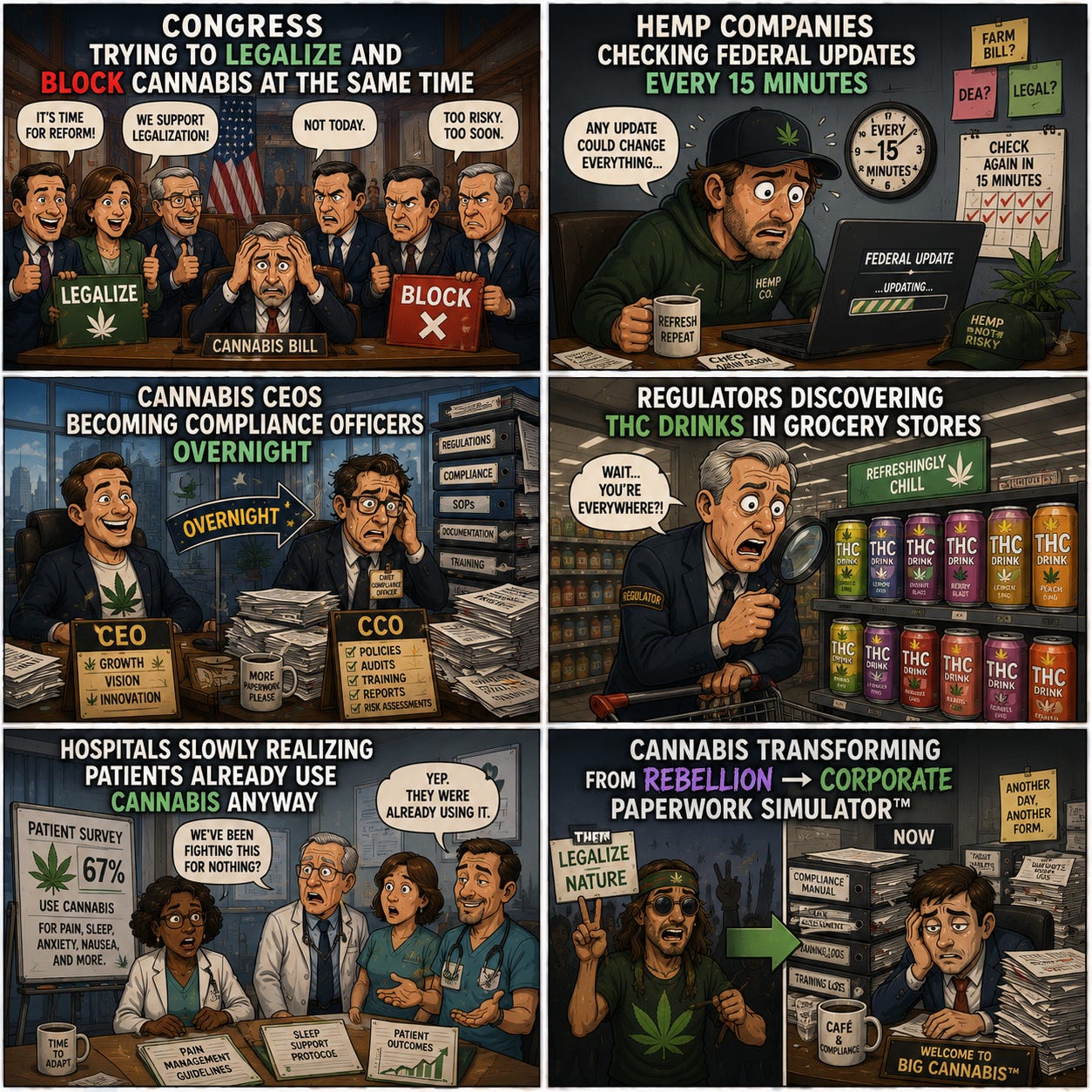
Congress Simultaneously Tries To Block Rescheduling
While reform expands in one room of Washington…
Resistance grows in another.
A congressional committee advanced efforts to block marijuana rescheduling despite the administration continuing forward with federal reform plans.
This perfectly captures modern cannabis politics:
Public support rises
Federal agencies adapt
Markets expand
Yet institutional resistance remains deeply embedded.
But opposition tactics have changed.
The old anti-cannabis argument focused on morality.
Now opponents fight through:
procedural delays,
committee votes,
appropriations language,
and regulatory complexity.
Cannabis reform has become too normalized to attack culturally.
So the fight has moved into bureaucracy.
Takeaway: Cannabis reform is no longer a social battle. It’s an institutional power struggle.
Washington Wants A Crackdown On Hemp THC Products
Congress is increasingly targeting the booming market for intoxicating hemp-derived cannabinoids.
Federal lawmakers are pressuring agencies to crack down on:
Delta-8 THC
Hemp-derived intoxicants
Synthetic cannabinoid products
Why?
Because the hemp loophole economy exploded faster than regulators expected.
Products once sold quietly online now exist:
in smoke shops,
gas stations,
beverage coolers,
and mainstream retail.
This is no longer fringe commerce.
And Washington clearly wants tighter control over:
safety,
taxation,
testing,
and distribution systems.
The free-for-all cannabinoid era may be ending.
Takeaway: Hemp-derived THC is becoming the next major federal cannabis battleground.
White House Clarifies Cannabis Is Still Federally Illegal
Despite rescheduling momentum, the White House emphasized this week that cannabis remains federally illegal.
That statement highlights the core contradiction shaping the industry right now.
Cannabis is simultaneously:
medically recognized,
federally restricted,
legal in many states,
and increasingly integrated into healthcare systems.
This fragmented structure creates massive uncertainty involving:
banking,
insurance,
interstate commerce,
taxes,
and institutional investment.
America is not moving directly from prohibition to legalization.
It’s moving into a layered regulatory framework where:
medical cannabis gains legitimacy first,
federal oversight expands,
and full legalization remains politically unresolved.
Takeaway: Cannabis reform is accelerating faster than federal legal clarity.
Louisiana Advances Hospital Medical Cannabis Access
Louisiana lawmakers advanced legislation allowing terminally ill patients to continue medical marijuana use while receiving hospital care.
This is another sign cannabis reform increasingly succeeds through healthcare normalization—not culture-war politics.
The core question lawmakers now face is simple:
If cannabis is medically legal…
why should patients lose access once entering hospitals?
Questions like this slowly force institutions to adapt.
And importantly:
this is happening in Louisiana—not California or Colorado.
That matters.
Because medical cannabis reform continues expanding in conservative states where broader recreational legalization still faces resistance.
Takeaway: Compassion-focused medical reform remains cannabis’s strongest political strategy.
Virginia Expands Marijuana Resentencing Relief
Virginia signed new legislation expanding resentencing relief tied to marijuana convictions.
This reflects a broader shift happening nationally:
Cannabis reform is moving back toward criminal justice conversations.
For years, legalization headlines focused heavily on:
market growth,
dispensaries,
tax revenue,
and investment.
Now lawmakers are increasingly confronting another reality:
People still carry criminal records for behavior now generating billions legally.
That contradiction is becoming harder to justify politically.
Takeaway: Cannabis reform is increasingly focused on repairing the damage created by prohibition-era enforcement.
CBD Research Pushes Cannabis Deeper Into Healthcare
A new scientific review found CBD shows potential as an anticancer treatment in dogs.
While niche on the surface, this reflects a much bigger trend:
Cannabis science is rapidly expanding beyond recreational narratives.
Researchers increasingly study cannabinoids for:
oncology,
inflammation,
neurological disorders,
veterinary medicine,
and chronic disease management.
Scientific legitimacy matters politically because it strengthens institutional durability.
The more cannabis integrates into healthcare and research systems, the harder it becomes to politically marginalize.
Takeaway: Science continues normalizing cannabis faster than politics alone ever could.
Cannabis Is Quietly Becoming Corporate America
The biggest shift happening right now isn’t legalization itself.
It’s institutionalization.
Cannabis companies increasingly operate like:
regulated healthcare firms,
compliance-heavy retailers,
and politically exposed industries.
The next era of cannabis won’t reward chaos.
It’ll reward:
compliance,
discipline,
capital access,
political relationships,
and operational maturity.
Because cannabis is no longer outside the system.
The system is absorbing cannabis now.
Takeaway: The cannabis industry is evolving from disruptive market → regulated institution.
Cannabis Has Crossed Into The Power Phase
Cannabis spent decades trying to enter mainstream America.
Now it’s discovering what happens after success.
Because once an industry becomes:
politically relevant,
medically integrated,
financially powerful,
and federally debated,
the real fight begins.
Not over existence.
Over:
control,
structure,
regulation,
and influence.
That’s the stage cannabis has officially entered now.
And the next winners won’t simply be the loudest voices.
They’ll be the people who understand how power moves inside the system cannabis is rapidly becoming part of.