
Cannabis Is No Longer Fighting for Legitimacy. It’s Fighting Over Control
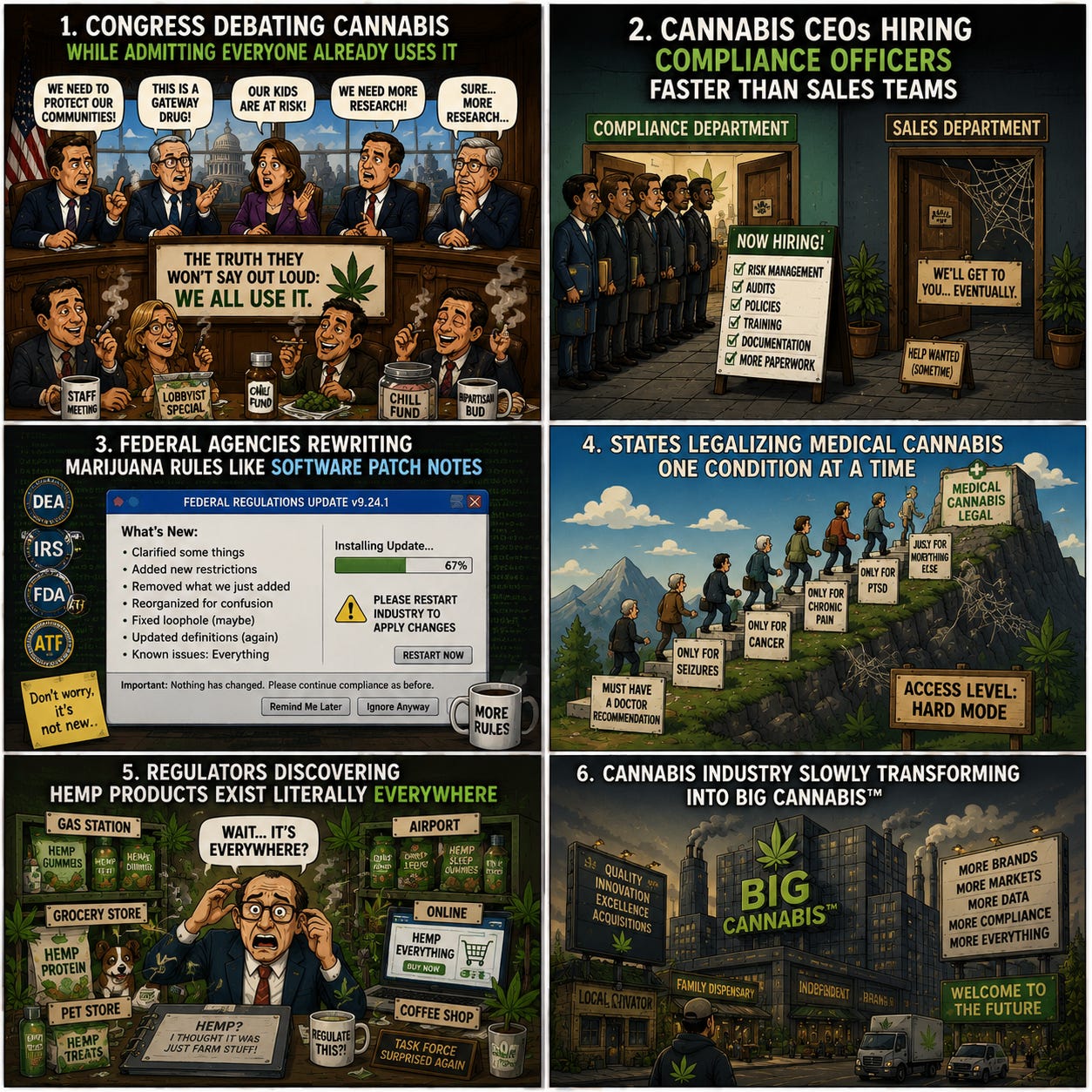
Cannabis is no longer operating outside American institutions. It’s inside them now.

The cannabis industry spent years trying to prove it belonged in mainstream America.
That argument is mostly over.
Now comes the harder phase:
Who gets to regulate it, profit from it, restrict it, and define its future?
Today’s latest developments reveal an industry entering full institutional conflict mode:
Congress wants tighter cannabinoid regulation
Federal agencies are rewriting enforcement systems
States are quietly preparing for legalization
Veterans and seniors are becoming major political drivers
Courts and lawmakers are battling over the limits of reform
This is no longer a fringe movement.
Cannabis is now:
Bureaucratic
Political
Corporate
Litigated
Deeply embedded in American systems
And once an industry reaches that phase, the conversation changes permanently.
Congress Pushes New Wave Of Cannabis Reform On Capitol Hill
Today’s biggest federal story is simple:
Cannabis reform legislation is accelerating again in Congress.
Lawmakers are actively advancing proposals involving:
Veterans access
Medical cannabis research
Banking protections
Federal oversight frameworks
But unlike earlier reform waves, this isn’t being framed as “legalization activism.”
It’s being framed as:
Governance
Regulation
Healthcare modernization
That distinction matters.
Washington increasingly treats cannabis as:
A policy management issue, not a culture war.
And once Congress starts debating how to administer an industry instead of whether it should exist, institutional acceptance becomes far harder to reverse.
The bigger shift is strategic.
Cannabis policy is no longer moving through single blockbuster bills alone.
Instead:
Committees
Amendments
Budget language
Administrative mechanisms
are quietly reshaping the industry piece by piece.
That’s slower.
But it’s also more durable.
Takeaway: Cannabis reform is becoming embedded into routine federal governance.
Congressional Committee Votes To Block Rescheduling
At the exact same time reform advances, resistance is intensifying.
A congressional committee voted to block federal cannabis rescheduling—even while the administration continues moving forward with implementation.
That contradiction defines modern cannabis policy perfectly.
Inside Washington:
Executive agencies are adapting to reform
Some lawmakers are still trying to stop it
Courts are preparing legal challenges
This means the next phase of cannabis won’t be driven by consensus.
It will be driven by institutional conflict.
And importantly, the opposition strategy is evolving.
Instead of focusing entirely on public opinion, opponents are now relying on:
Administrative law
Committee votes
Technical procedural challenges
That’s what happens when public support becomes harder to fight directly.
The political battlefield shifts into bureaucracy.
Takeaway: Cannabis reform is now powerful enough to trigger organized institutional resistance.
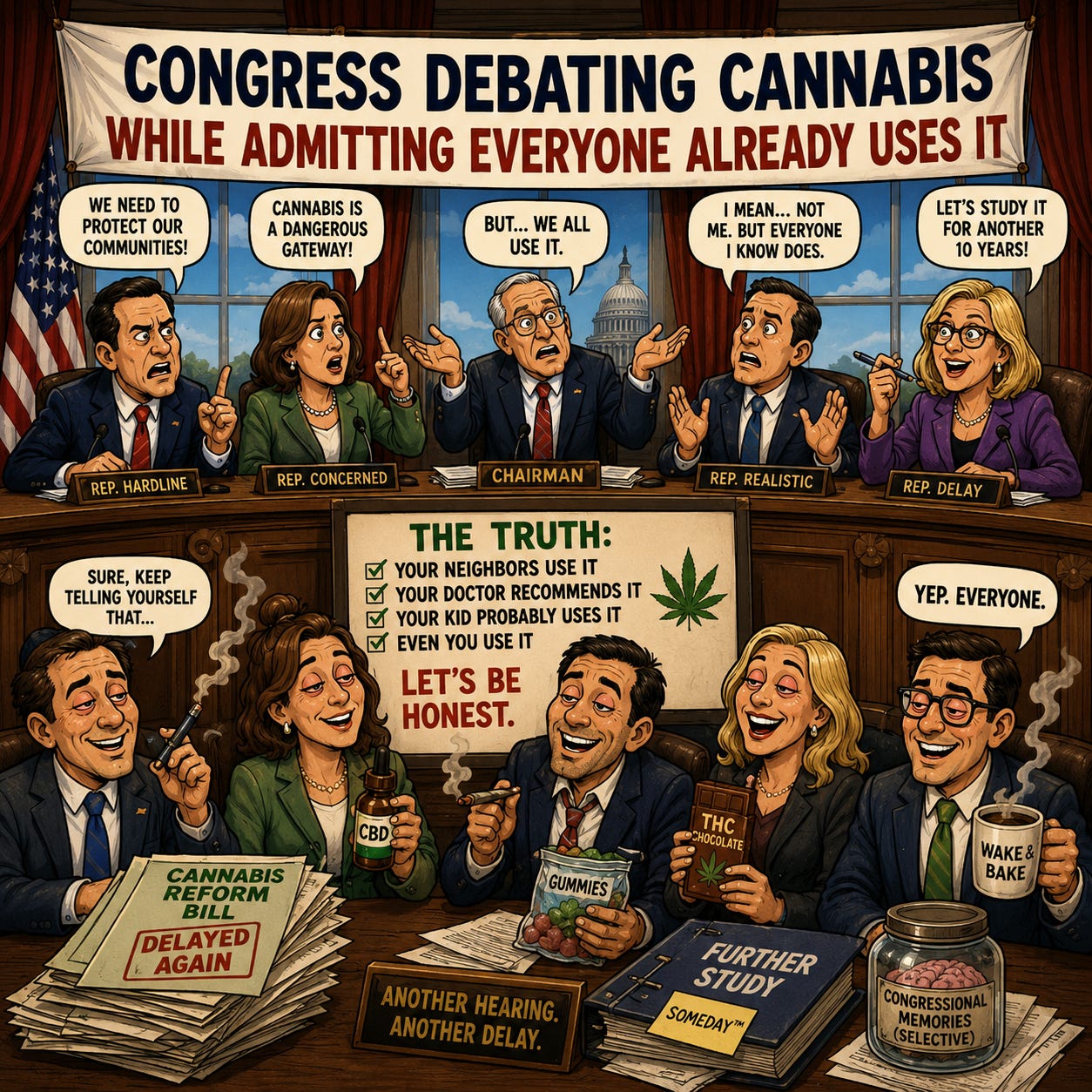
Congress Admits Cannabis Use Is Common Inside Government
One of today’s most revealing moments came from Congress itself.
A lawmaker openly acknowledged:
“There are a lot of people who smoke cannabis in Congress.”
That statement matters culturally more than legislatively.
Because it reflects a major normalization milestone:
Cannabis use is no longer politically shocking even inside federal institutions.
For decades, Washington treated marijuana as:
Dangerous
Deviant
Career-ending politically
Now lawmakers discuss it casually.
That doesn’t mean prohibition disappears overnight.
But it does mean the stigma barrier keeps collapsing.
And politically, stigma collapse changes everything:
Reform becomes safer
Opposition weakens
Institutional hypocrisy becomes harder to sustain
This is how social normalization quietly reshapes policy long before laws fully catch up.
Takeaway: Cannabis has become culturally normalized inside institutions that once aggressively criminalized it.
Louisiana Advances Hospital Medical Cannabis Bill
Louisiana lawmakers advanced legislation allowing terminally ill patients to use medical cannabis in hospitals.
This is another sign cannabis reform increasingly moves through compassion-focused healthcare policy rather than broad legalization campaigns.
The proposal would allow patients with irreversible conditions to continue cannabis treatment while receiving hospital care.
That may sound narrow.
But politically, it’s powerful.
Because these reforms force institutions to confront uncomfortable contradictions:
If cannabis is medically legal…
Why must terminal patients stop treatment when entering hospitals?
Questions like that gradually erode resistance at the institutional level.
And notably:
This is happening in Louisiana—not exactly a traditional legalization stronghold.
Medical cannabis reform continues expanding faster than recreational legalization because healthcare framing lowers political resistance dramatically.
Takeaway: Compassion-based medical reforms remain one of cannabis’s strongest political pathways.
Georgia Expands Medical Marijuana Access
Georgia Gov. Brian Kemp signed legislation significantly expanding the state’s medical marijuana program.
The new law:
Adds qualifying conditions
Allows vaping products
Expands patient access
And importantly, this is happening in a conservative Southern state.
That reveals one of the biggest trends in American cannabis policy right now:
Medical marijuana expansion continues outpacing recreational legalization in Republican-led states.
Why?
Because medical framing:
Feels more controlled
Feels more compassionate
Creates less political backlash
Georgia may still resist adult-use legalization.
But every medical expansion normalizes the broader industry further.
And over time, those incremental reforms compound politically.
Takeaway: Medical cannabis remains the most politically resilient form of reform in conservative America.
Indiana Republicans Quietly Shift Toward Medical Cannabis
In another sign the political center is shifting, an Indiana Republican senator announced plans to introduce medical marijuana legalization legislation in 2027.
That’s highly significant because Indiana has historically resisted cannabis reform aggressively.
But geographic and political pressure are mounting:
Neighboring states legalized
Public support continues rising
Economic isolation becomes harder to justify
And increasingly, Republican lawmakers are reframing cannabis around:
Medical access
States’ rights
Healthcare alternatives
rather than culture war politics.
This doesn’t mean Indiana suddenly becomes a legalization leader.
But it does show how politically isolated prohibition states are becoming.
Takeaway: Even longtime holdout states are slowly being pulled toward reform.
New Studies Push Cannabis Deeper Into Healthcare Conversations
Fresh research from UC Riverside suggests cannabis compounds may eventually help address obesity and metabolic disorders.
Researchers found:
THC-treated mice lost weight
Full-spectrum cannabis oils improved metabolic function
Certain compounds may influence diabetes-related processes
Importantly, researchers cautioned this is not an endorsement of recreational cannabis for weight loss.
But politically and medically, studies like this matter enormously.
Because healthcare legitimacy increasingly drives cannabis normalization.
The industry’s future may depend less on:
Lifestyle branding
Counterculture identity
and more on:
Clinical applications
Pharmaceutical pathways
Wellness integration
Takeaway: Science continues pushing cannabis deeper into mainstream healthcare discussions.
The Cannabis Industry Is Quietly Becoming Corporate America
The biggest shift this week isn’t any single bill or lawsuit.
It’s behavioral.
Cannabis companies are changing.
The old priorities:
Hypergrowth
Hype
Market grabs
The new priorities:
Compliance
Institutional partnerships
Regulatory survival
Political stability
Because federal involvement changes incentives.
And once industries become tied to:
Congressional committees
DEA registration systems
Healthcare infrastructure
Mainstream retail
they stop behaving like frontier markets.
Cannabis is entering that phase now.
Takeaway: Cannabis is evolving from disruptive industry → managed institution.
Cannabis Has Officially Entered The System
Today’s biggest takeaway is simple:
Cannabis is no longer operating outside American institutions.
It’s inside them now.
Inside:
Congress
Hospitals
Federal agencies
Healthcare debates
Corporate retail systems
And once an industry reaches that point, the fight changes forever.
The debate is no longer:
“Should cannabis exist?”
Now it’s:
“Who controls what cannabis becomes?”