
Cannabis Policy’s Dynamic Week: Ballots, Budgets, Bans & Federal Court Battles
From Texas voters weighing in to federal legal fights over guns and marijuana, today’s top cannabis news paints a picture of reform, resistance, and regulatory uncertainty.

Cannabis at the Tipping Point of Public Policy
Today’s cannabis policy landscape feels like a nexus of grassroots democracy, federal legal wrangling, and state regulatory pivots. Voters in Texas are literally voting on legalization in the midst of the state’s primary elections, reflecting how reform continues to move via direct democracy. Simultaneously, statehouses from Hawaii to Missouri are crafting laws that either expand access or tighten rules on hemp products. At the national level, a major Supreme Court battle looms as the Justice Department argues gun‑possession bans for marijuana users are constitutional — even as federal rescheduling efforts continue under executive order. Meanwhile, New York City’s tax projections reveal both the promise and growing pains of mature cannabis markets.
Here are the eight most recent articles shaping the conversation today, each rewritten with in‑depth analysis and concrete takeaways.
DOJ Argues for Upholding Federal Gun Ban for Marijuana Users at Supreme Court
In a filing that could ripple across both cannabis and gun policy, the U.S. Department of Justice urged the Supreme Court to uphold Section 922(g)(3) of federal law — a statute that prohibits people who use marijuana from owning or possessing firearms. DOJ’s argument frames cannabis use as inherently dangerous, asserting historical analogues exist that justify gun restrictions for users. Importantly, this position persists even as the administration simultaneously pursues federal rescheduling of marijuana from Schedule I to Schedule III under executive order — a change meant to ease research and therapeutic use restrictions.
The case, U.S. vs. Hemani, has attracted briefs from diverse stakeholders, from the National Rifle Association claiming the ban is unconstitutional, to dozens of state attorneys general backing the government’s statute. DOJ’s stance hinges on the notion that cannabis remains a uniquely hazardous drug despite evolving legal landscapes.
Why It Matters
This Supreme Court showdown will test whether federal gun rights and cannabis policy can coexist in a legal framework that is increasingly divergent from public opinion and state law reforms.
Clear Takeaways
✔ DOJ told SCOTUS that federal firearm restrictions for marijuana users should be upheld.
✔ This stance stands even amid federal rescheduling efforts.
✔ Outcome could shape future intersections of cannabis law and Second Amendment rights.
Marijuana Legalization Is Now on the Ballot in Texas During Today’s Primary Election
As Texas voters participate in the state’s primary elections, Democratic voters are being asked to weigh in on whether marijuana should be legalized statewide. The ballot item represents a strategic push by advocates to drive reform through direct democracy mechanisms in a traditionally conservative state where legislative action has lagged behind neighboring states.
The measure’s presence in the primary reflects both grassroots mobilization and shifting attitudes among the Texas electorate — signaling broader national patterns where cannabis legalization is gaining traction even in regions once considered resistant.
Why It Matters
Texas, with its economic and cultural weight, could become a tipping point state in the legal cannabis movement. A successful ballot initiative could reshape regional markets and prompt legislative responsiveness.
Clear Takeaways
✔ Cannabis legalization is on the ballot in the Texas primary.
✔ The measure reflects deepening reform momentum even in conservative jurisdictions.
NYC Mayor Mamdani Projects Growing Cannabis Tax Revenue Amid Rapid Retail Expansion
New York City’s cannabis market continues expanding, with licensed dispensaries doubling in just one year. While tax revenues have increased significantly — with projections estimating $43 million by fiscal year 2030 — the city also grapples with lower per‑store sales due to competitive pressures and falling prices.
Mayor Zohran Mamdani’s 2027 budget forecast highlights both the promise and challenges of adult‑use legalization in major urban centers. It underscores the need for continued regulatory vigilance and market support to ensure long‑term revenue growth and consumer safety.
Why It Matters
NYC’s evolving cannabis economy offers a model (and cautionary tale) for other cities navigating the balance between robust retail markets and revenue expectations.
Clear Takeaways
✔ Dispensary count in NYC has doubled in recent months.
✔ Cannabis tax revenue is rising but faces headwinds from competition and pricing.
New York Lawmakers Seek to Allow Low‑THC Cannabis Beverage Sales in Liquor Stores
New York lawmakers introduced companion bills that would allow licensed liquor and wine stores to sell low‑THC cannabis beverages under a new permitting system. These drinks would be capped at low potency (no more than 5 mg of THC) and sold in licensed off‑premise retailers alongside alcohol.
Sponsored by Democratic legislators in both the Senate and Assembly, the proposal aims to integrate cannabis into existing regulated retail frameworks while expanding legal access and targeting illicit markets.

Why It Matters
This legislation showcases an emerging trend: cross‑sector retail integration of cannabis products in mature markets under controlled regulatory overlays.
Clear Takeaways
✔ NY legislators filed bills to let liquor stores sell low‑THC cannabis drinks.
✔ Retail permit system designed to expand access while ensuring oversight.
Missouri House Passes Bill to Ban Hemp‑Derived THC Drinks & Edibles
The Missouri House overwhelmingly approved legislation to ban intoxicating hemp‑derived THC products — including beverages and edibles — that are currently widely sold at convenience stores and smoke shops. Under the bill, products with more than 0.4 mg of THC per container would be prohibited unless sold in licensed marijuana dispensaries.
Advocates of the ban argue it aligns state law with recent federal action, facilitating enforcement and closing perceived loopholes. Critics contend it may drive consumers to the unregulated market or conflict with future federal decisions on hemp regulation.
Why It Matters
This move highlights ongoing state responses to federal hemp policy uncertainty and the tension between public safety goals and market realities.
Clear Takeaways
✔ Missouri House moved to ban intoxicating hemp THC products.
✔ Lawmakers say action aligns with federal law, critics warn of unintended consequences.
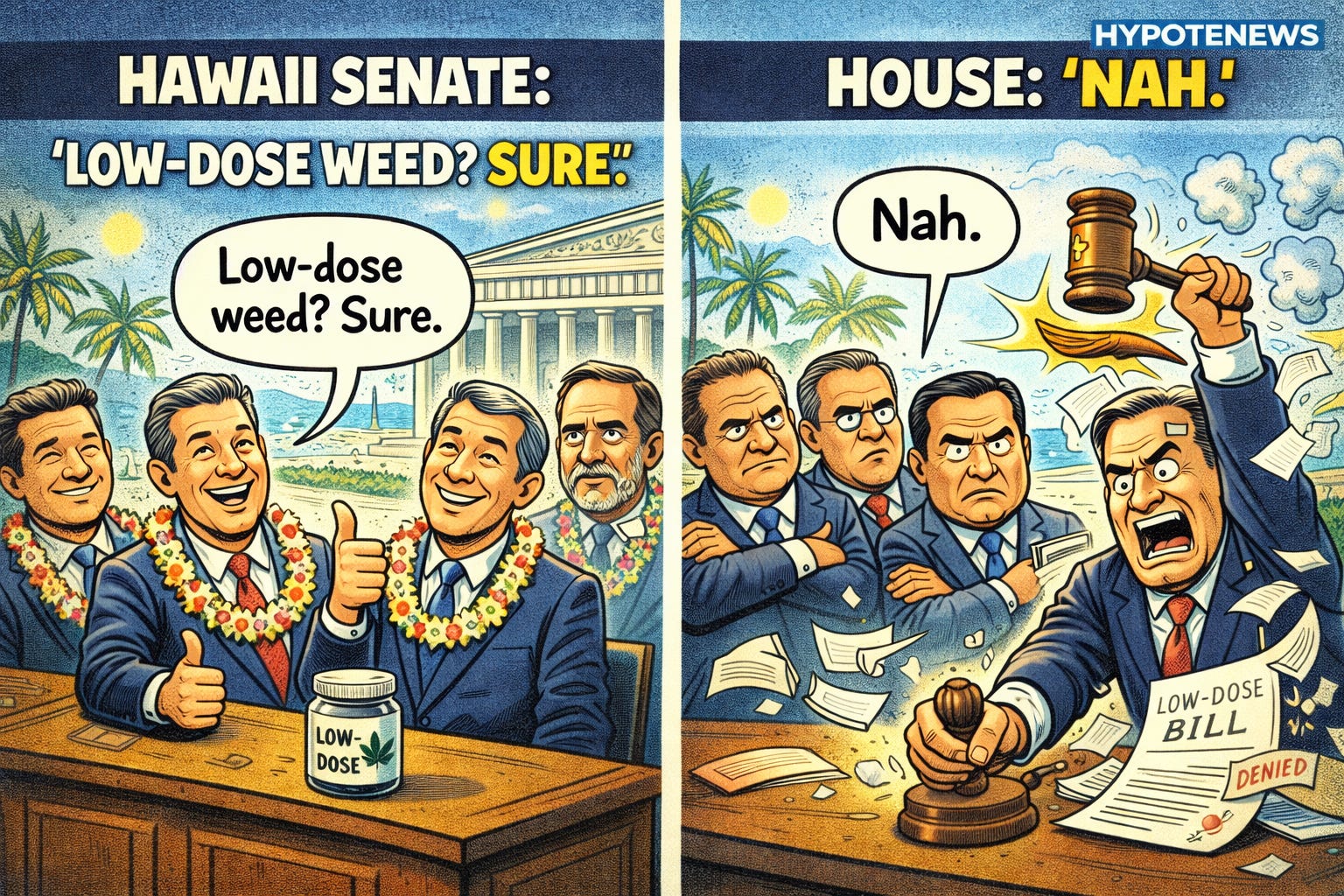
Hawaii Senators Approve Limited Marijuana Legalization Bill After House Punts on Reform
Hawaii’s Senate Health and Commerce committees advanced a bill that legalizes low‑dose, low‑potency cannabis for adults 21 and older, despite the state House signaling it won’t move full reform this year. The legislation permits possession and use of very limited amounts of THC (e.g., up to 5 mg per serving) but does not create a commercial cultivation or sales framework.
The bill’s passage represents a compromise approach intended to break the stalemate between reform advocates and House leaders who have been reluctant to pursue broader legalization.
Why It Matters
This hybrid policy reflects a nuanced path toward legalization — offering incremental access while avoiding full commercial rollouts within the current legislative session.
Clear Takeaways
✔ Hawaii Senate passed a limited legalization bill focused on low‑dose cannabis.
✔ No commercial sales system included, reflecting legislative compromise.

Pennsylvania City Officials Urge State Lawmakers to Legalize Marijuana This Year
The Pittsburgh City Council unanimously adopted a resolution urging Pennsylvania lawmakers and the governor to legalize adult‑use cannabis during the 2026 legislative session. Citing neighboring states that have already moved forward on reform and the missed opportunities for tax revenue and justice reform, local leaders framed legalization as both an economic and social equity priority.
Why It Matters
This kind of municipal pressure adds momentum in states that have so far lagged in legislative action, especially where regional policies are shifting quickly.
Clear Takeaways
✔ Pittsburgh officials formally called for 2026 legalization.
✔ City leaders emphasized economic and justice considerations.
Arizona Senators Consider Criminalizing “Excessive” Marijuana Smoke
Arizona lawmakers introduced bills that would make “excessive” marijuana smoke — even on private property where cannabis use is legal — a nuisance crime punishable by fines, probation or jail time. Critics say the measure’s vague language could have broad implications for private cannabis users and enforcement, potentially echoing early tobacco nuisance laws.
Why It Matters
This proposal highlights how legislatures can respond to community concerns with punitive measures, even in states that have legalized cannabis — a reminder that legalization does not always preclude restrictive local policies.
Clear Takeaways
✔ Arizona senators introduced measures to penalize “excessive” cannabis smoke.
✔ Vague wording could widen enforcement scope beyond intended targets.
Nuanced Progress Amid Legal Complexity
Today’s cannabis policy news reflects a tapestry of reform and restriction, where direct democracy, municipal pressure, and regulatory innovation push forward even as federal courts and some state legislatures impose constraints. With Texas voters weighing in, New York shaping robust retail frameworks, and polarizing federal legal arguments unfolding at the nation’s highest court, 2026 continues to be a year of contrasts and potential turning points in cannabis law