
Four States, Four Completely Different Ideas of What “Regulated Weed” Means
DEA is drawing a hard line on synthetic cannabinoids, Illinois is merging medical and rec, Virginia gave businesses 40 days before a rule that could bankrupt them, and Big Alcohol just asked for keys.

Here’s a snapshot of American cannabis policy in a single 48-hour window. The DEA drew a hard line insisting a synthetic cannabinoid stays Schedule I. Illinois moved the opposite direction, letting adult-use dispensaries serve medical patients at the lower tax rate. Virginia is about to erase a hemp exception on Saturday, giving businesses roughly 40 days to reformulate or eat their inventory, with one owner saying it could bankrupt her. And Houston is sending voters a measure to make marijuana arrests the lowest priority for city police.
Same country. Same plant. Four completely different theories of how to regulate it.
If you’re still picturing cannabis as one big national argument, legal versus illegal, pro versus anti, feds versus states, that frame has stopped being useful. The real fight now is quieter and far more consequential: who regulates which cannabinoid, under what commercial system, at what tax rate, with how much transition time. Those questions sound boring next to “legalize it.” They’re not. They decide who survives. A 5mg THC seltzer treated like alcohol gets national wholesalers and mainstream retail. The same molecule packaged differently faces prohibition. This is what a maturing industry looks like, and the businesses that figure that out first are going to have a massive edge. Let me walk you through it.
The DEA is separating cannabis chemistry from cannabis agriculture, and it changes everything.
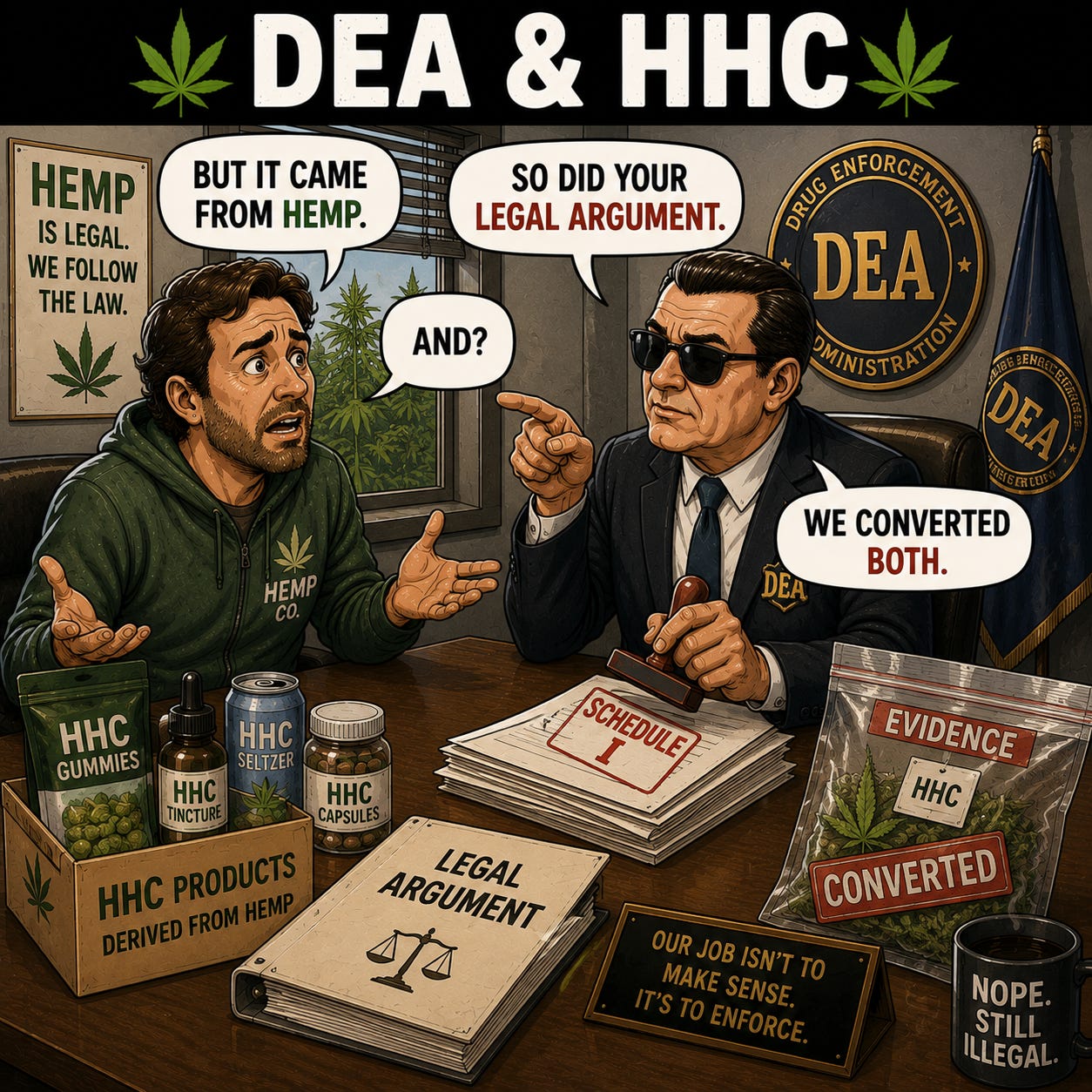
The DEA is defending its position that HHC, a cannabinoid made through chemical conversion, is already Schedule I, escalating a legal fight that could shape how federal law treats converted cannabinoids across the board. Back in May, the agency gave HHC its own drug code. Hemp companies challenged it, arguing some HHC products qualify as lawful hemp. The DEA’s clever response: the new code didn’t change anything, because HHC has been Schedule I for decades thanks to its relationship to THC, and the code is just an administrative tracking tool, not a new act of prohibition.
That sounds like dry procedural stuff. Commercially, it’s enormous. The whole post-2018 cannabinoid market is built on products that start as lawful hemp material and then get chemically converted before they hit the shelf. Delta-8 was the famous example. HHC followed. And regulators are increasingly focused not on where a cannabinoid came from, but on how it came to exist.
“Hemp-derived” may be losing its power as a legal defense. The molecule’s origin story matters less than its manufacturing process now, and that’s a completely different question.
That reframes what a banker underwriting one of these companies should even be asking. Not just “is it hemp,” but: what molecule is this, does it occur naturally in cannabis at useful concentrations, does the process convert CBD into the finished compound, what solvents and catalysts get used, what’s the federal legal theory. Those stopped being chemistry questions and became credit questions. And there’s a double bind here, because the DEA also points to the broader November hemp change, when the federal definition tightens sharply unless Congress acts. So even a company that beats the DEA’s interpretation could still get squeezed by Congress. The strongest hemp businesses from here on will be the ones that can survive without leaning on legal ambiguity.
The bottom line: The federal government is starting to distinguish cannabis chemistry from cannabis agriculture. Calling something “hemp-derived” may no longer be enough, and the production method is becoming as important as the plant it came from.
Illinois is blurring the line between medical and rec, on purpose.
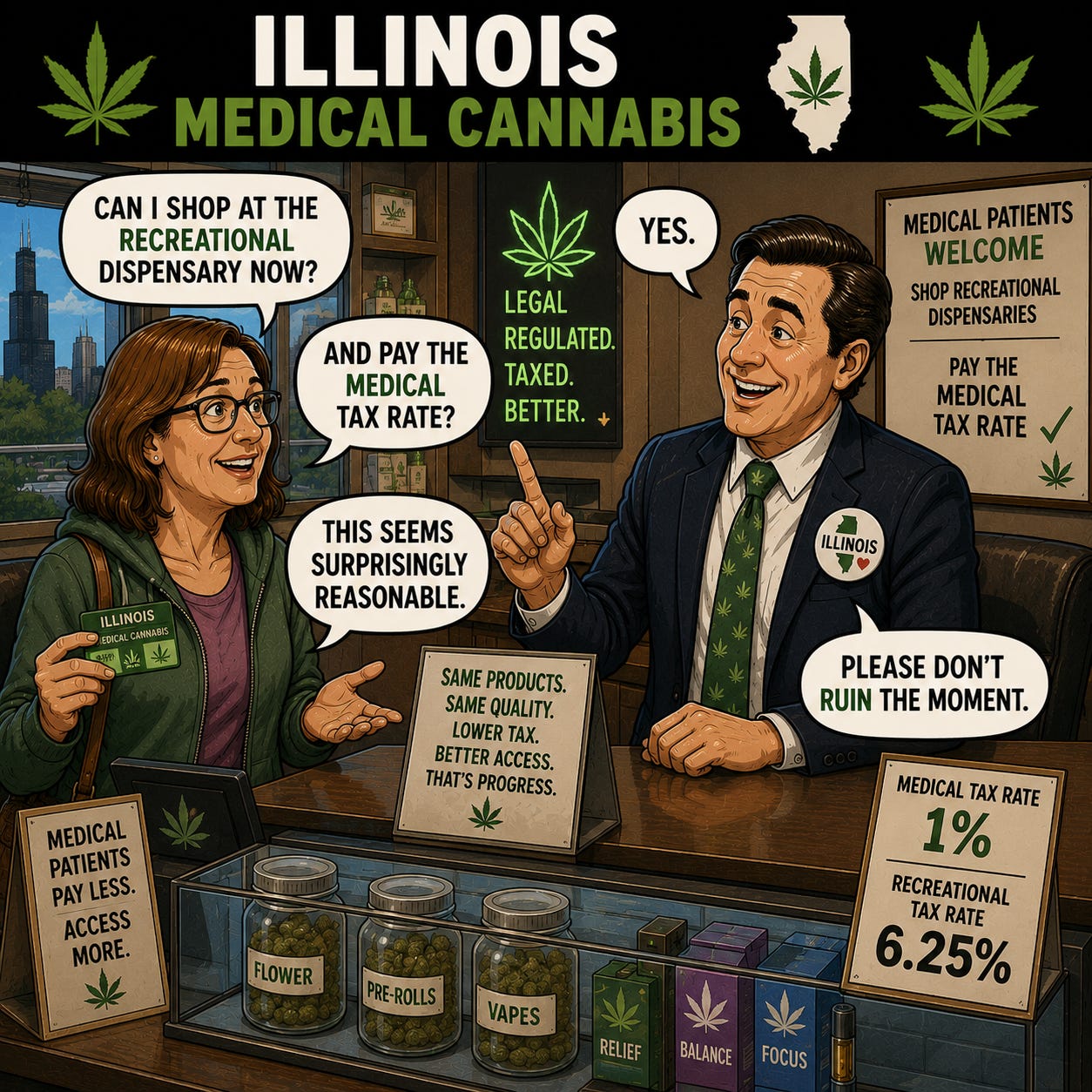
Illinois published a new application letting licensed adult-use dispensaries in good standing get a separate authorization to sell medical cannabis, with applications opening September 10. It came out of the broader cannabis law Governor Pritzker signed earlier this year, and stores that get the extra license can serve registered patients at the lower medical tax rate.
This isn’t a simple checkbox, though. Operators pay a $5,000 non-refundable application fee, face another $10,000 in renewal costs, and have to submit ownership, disciplinary, and tax-compliance info. More interesting, they have to explain how they’ll actually prioritize medical patients, including dedicated lines or registers and a consultation area. That detail matters, because legalization tends to quietly strangle medical programs.
Adult-use markets are bigger, busier, and more profitable. Left alone, they turn medical patients into an afterthought inside an industry that was originally built for them.
Illinois is trying to preserve the medical distinction while expanding where patients can shop, which is a genuine win, more locations means less travel and more competition. And the tax gap is real money for someone using cannabis regularly for pain or cancer treatment, because taxes compound fast on recurring purchases. The broader law goes further too, doubling possession limits, expanding expungement, and adding qualifying conditions like endometriosis and uterine fibroids, while also tightening hemp THC rules to match the coming federal 0.4mg framework. That combination is the tell. Illinois isn’t simply “pro-cannabis.” It’s sorting cannabinoids into clearly defined lanes: expand access for licensed marijuana and medical, restrict hemp products outside the favored framework. That may become the dominant state playbook. For operators, the medical opt-in is a new revenue channel but also a real service obligation, since medical patients need staff who actually know the products and reliable access to specific formulations, not just a discount.
The bottom line: Illinois is building one retail network serving different consumer classes under different rules. It makes commercial sense, but if adult-use stores want medical revenue, they need to deliver genuinely medical-level service.
Virginia gave hemp businesses 40 days, and it could bankrupt them.
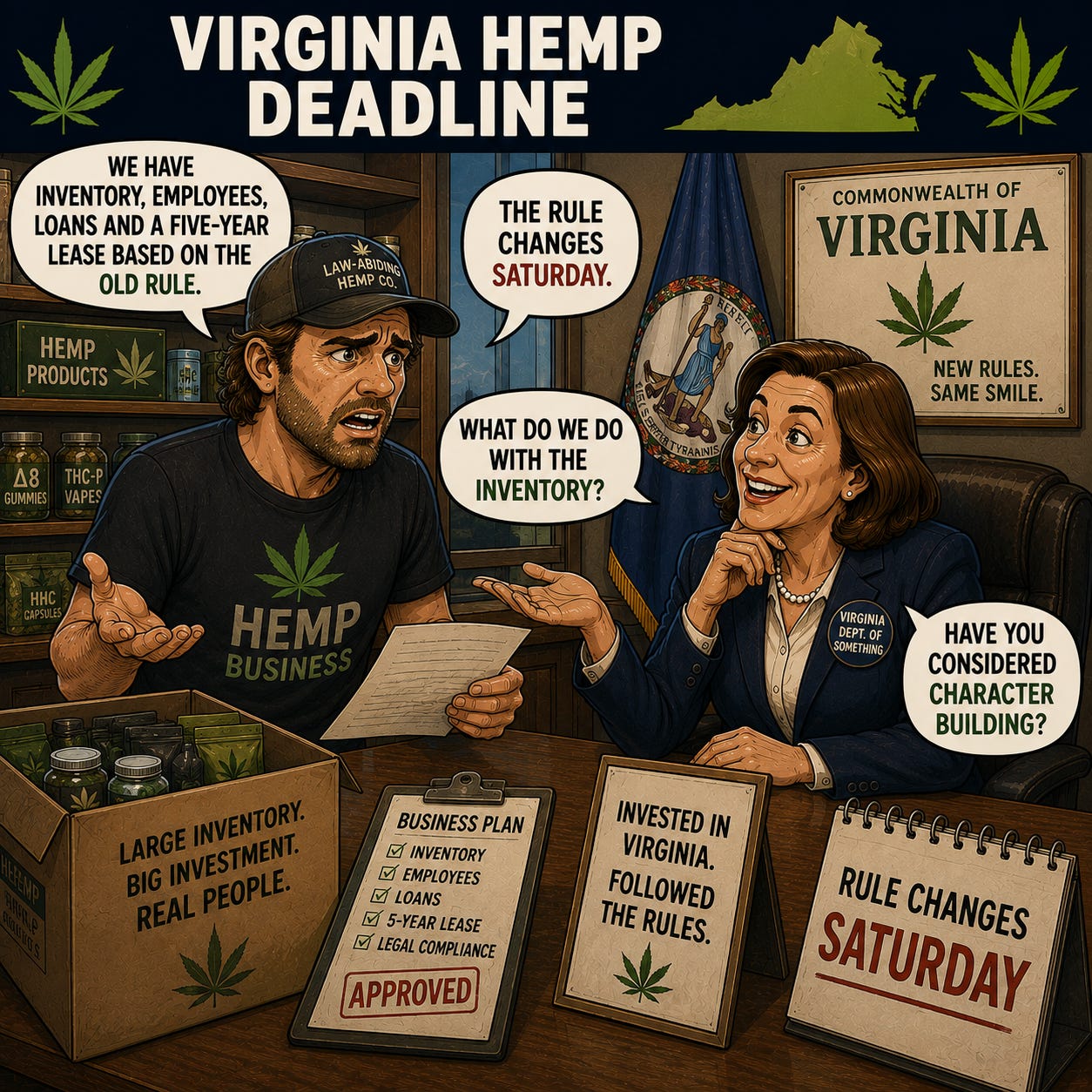
Virginia is about to become the clearest example of what happens when a regulatory change slams into business debt. Seven hemp companies are asking a federal court to block new restrictions taking effect August 15. The change kills an exception that let certain hemp products carry more than 2mg of THC per package as long as they also had at least 25 times as much CBD. Without it, consumable hemp products generally have to stay under 2mg total THC per package.
The businesses say the economics are brutal. They were formally notified in early July, leaving roughly 40 days to reformulate products, redesign packaging, renegotiate manufacturing, and figure out what to do with inventory that’s about to become unsellable. District Hemp Botanicals founder Barbara Biddle says it could bankrupt her company, which has affected inventory, substantial creditor obligations, has already cut staff, and expects to end a store lease. Virginia officials defend it on consumer-protection grounds, and Attorney General Jay Jones says it creates clearer standards ahead of the state’s developing recreational market.
Here’s the thing: both can be true. Virginia has a legitimate interest in deciding which intoxicating products sell outside its licensed system. And businesses have a legitimate expectation that a dramatic rule change comes with enough transition time that lawful inventory doesn’t turn into an overnight liability. That second issue gets almost no attention in cannabis policymaking, and it should. Picture a company that borrowed $250,000 for inventory, packaging, and a multiyear lease. Every product was legal when purchased. Then the standard changes.
The regulator changes the value of the collateral without changing any of the obligations attached to it. The bank still wants payment. The landlord still wants rent. The inventory is just suddenly worthless.
That’s why transition periods matter, and they’re not favors to industry, they’re basic tools of predictable regulation. Sell-through windows, grandfathering inventory by manufacture date, phasing potency changes gradually. And Virginia’s situation is especially odd because it’s simultaneously building a future adult-use market that may allow products with far more THC than the hemp products it’s banning today. Critics argue that’s inconsistent treatment based on regulatory channel rather than actual risk, and they have a point.
The bottom line: Businesses can survive stricter regulation. What destroys them is regulation without transition. Turning lawful inventory into unsellable inventory in 40 days isn’t just regulating health risk, it’s reallocating financial losses.
Houston isn’t asking voters to like weed. It’s asking them to price prohibition.
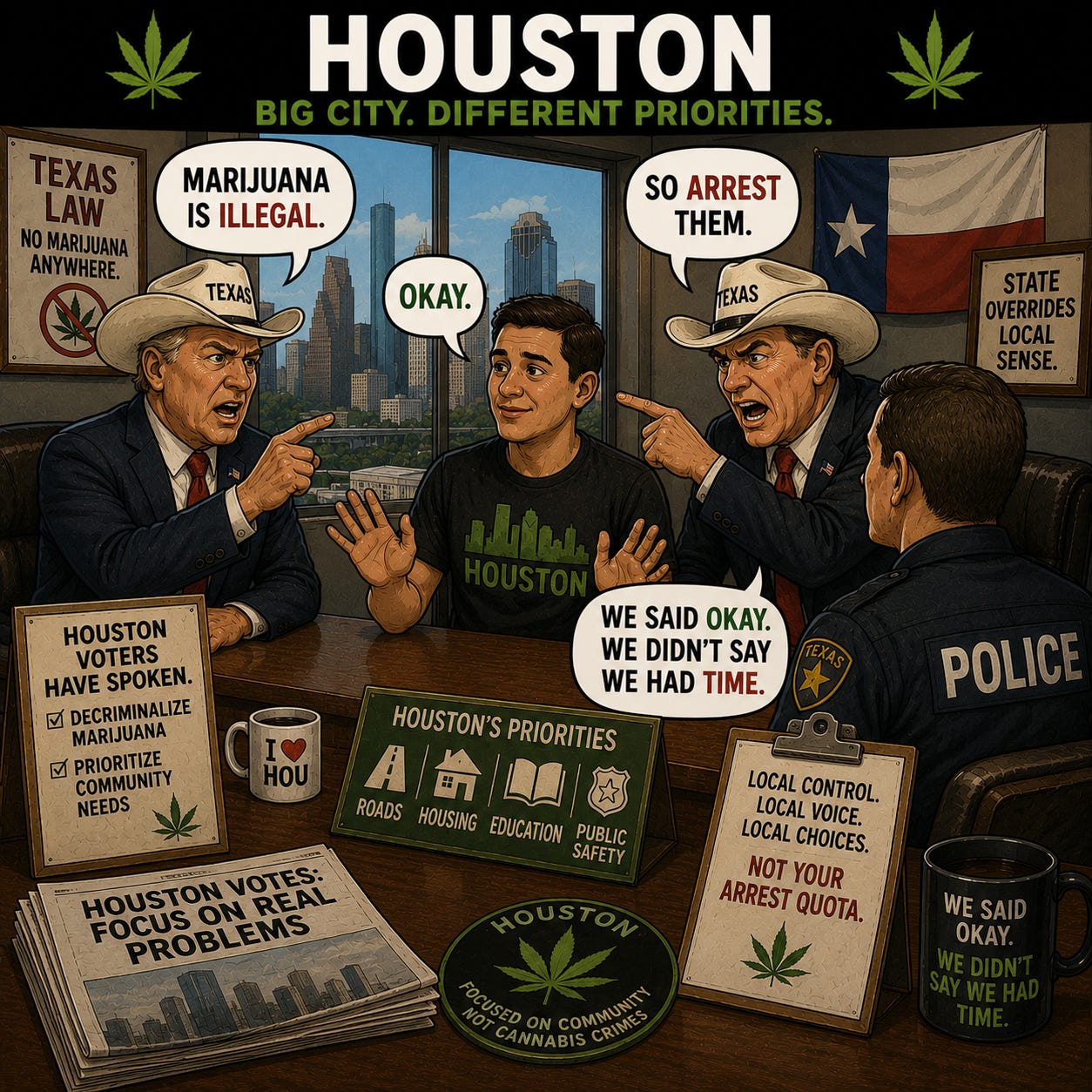
Houston’s cannabis initiative is officially going to voters. The City Council put the Houston Freedom Act on the November ballot after organizers turned in nearly 40,000 signatures, and if it passes, misdemeanor marijuana possession becomes the lowest possible enforcement priority for city police.
Important distinction: this does not legalize cannabis. Texas law stays intact, and officers could still seize suspected marijuana with probable cause. But the city would formally steer scarce enforcement resources away from misdemeanor possession toward higher-priority public safety. And that framing might be the single most effective cannabis reform argument in prohibition states.
Don’t ask the voter “do you approve of marijuana?” Ask “should police spend their time on this?” Those are completely different questions, and the second one wins in places the first one loses.
Someone can personally dislike cannabis and still think an officer’s time is better spent on robberies, assaults, or car theft. The initiative leans right into that, talking about resource allocation, reducing discriminatory enforcement, and diversion options like community service. It turns cannabis policy into municipal budgeting: how many officer hours, how much evidence processing, lab testing, prosecutor time, jail capacity. Once you measure enforcement economically, the political math shifts. Texas is especially interesting because state policy is tightening on hemp cannabinoids at the same time, so a Houston voter could be asked to care less about ordinary possession while the state cracks down on products sold openly through hemp channels. That contradiction won’t be easy to explain. And it shows why local reform matters, because normalization often happens city by city, a prosecutor declines cases, police deprioritize, a city builds diversion, until statutory prohibition drifts away from actual enforcement and the pressure moves upward. For businesses, Houston is a signal, since Texas is one of the biggest unrealized adult-use markets in the country.
The bottom line: Houston isn’t asking voters to embrace marijuana. It’s asking them to price prohibition. Once enforcement becomes a resource-allocation decision instead of a morality debate, reform gets much harder to dismiss.
A Republican senator says Trump is “misinformed” about hemp, and the whole fight is scrambled.
The federal hemp fight has gotten so politically tangled that a Republican senator is now publicly criticizing a Republican president’s grasp of the issue. Sen. Ted Budd of North Carolina says Trump has been “misinformed” by White House staff about the consequences of the coming hemp restrictions. Budd led the failed Senate effort to keep the November crackdown on schedule, which got tabled 61 to 32, preserving language that would delay most restrictions to December 11 if the funding measure becomes law. The White House backed the delay. Budd didn’t.
A lot of the disagreement is about CBD. CMS Administrator Dr. Mehmet Oz warned that rushing the restriction could undermine federal healthcare initiatives involving hemp products, while Budd argues policymakers are confusing non-intoxicating CBD with the intoxicating market he wants restricted. And that confusion is exactly the problem.
“Hemp” now describes industrial fiber, CBD tinctures, 5mg beverages, delta-8 gummies, THCA flower, converted cannabinoids, and novel synthetics. Governing all of that with one definition is becoming impossible.
The government wants to solve it through definitions. Industry increasingly wants product-specific rules. Those approaches are colliding. And there’s an irony worth noting: Trump signed the original 2018 Farm Bill that created this market, then signed the legislation with the tighter definition, and his administration is now urging Congress to soften the impact. That’s not necessarily hypocrisy, it may just reflect how radically the industry mutated after 2018. Congress legalized an agricultural category, entrepreneurs turned it into a national cannabinoid consumer market, and regulation never caught up. Here’s the upside for the industry, though: hemp used to be politically vulnerable when one party could tag it as the other party’s issue. Now it cuts across agriculture, healthcare, beverages, small business, and consumer safety. Messier coalitions, but potentially more durable ones.
The bottom line: Hemp is no longer Republican versus Democrat. It’s product versus product, regulator versus regulator, constituency versus constituency. That fragmentation may be exactly what eventually forces Congress to regulate cannabinoids individually instead of with one blunt definition.
North Carolina’s hemp chaos is a warning: you can’t scale chaos.
A Marijuana Moment op-ed from North Carolina hemp operator Chris Karazin makes a point that’ll ring true for basically every regulated cannabis business: you cannot scale chaos. He describes burning enormous time tracking constantly shifting legislation instead of serving customers or planning growth, and argues Congress should learn from North Carolina before designing the next national framework.
The state’s House Bill 328 started narrow, aimed at hemp on school property, then ballooned during the process until it threatened broad categories of existing products. That produced the exact uncertainty operators hate: what inventory do we buy, do we hire, do we sign another lease, should a farmer plant next year’s crop, will this product even be legal when it reaches the shelf. And here’s the nuance politicians keep missing: Karazin isn’t anti-regulation. He supports age limits, testing, labeling, manufacturing standards, enforcement. His objection is unpredictability.
Industry resistance to a rule doesn’t always mean the industry wants no rules. Sometimes it just means they need to know what the rule will be long enough to build a company around it.
This should matter intensely to lenders, because credit runs on predictability. A bank doesn’t need a cannabis borrower operating in a zero-regulation Wild West, quite the opposite, clear rules improve underwriting. The lender wants to know what’s legal, what license is required, what happens on a violation, whether inventory can cross state lines. Regulatory certainty creates measurable risk. Regulatory chaos creates unmeasurable risk, and unmeasurable risk either drives financing costs up or eliminates financing entirely. North Carolina also shows the danger of treating all cannabinoids as identical, when THCO, THCP, THCV, CBD, and low-dose delta-9 have dramatically different pharmacology. One blunt rule is administratively easy and economically irrational.
The bottom line: The hemp industry’s strongest argument is no longer “leave us alone.” It’s “give us strict rules and stop changing them every few months.” Predictable regulation attracts capital. Uncertainty sends it running.
Michigan is discovering you can tax yourself out of the revenue you wanted.
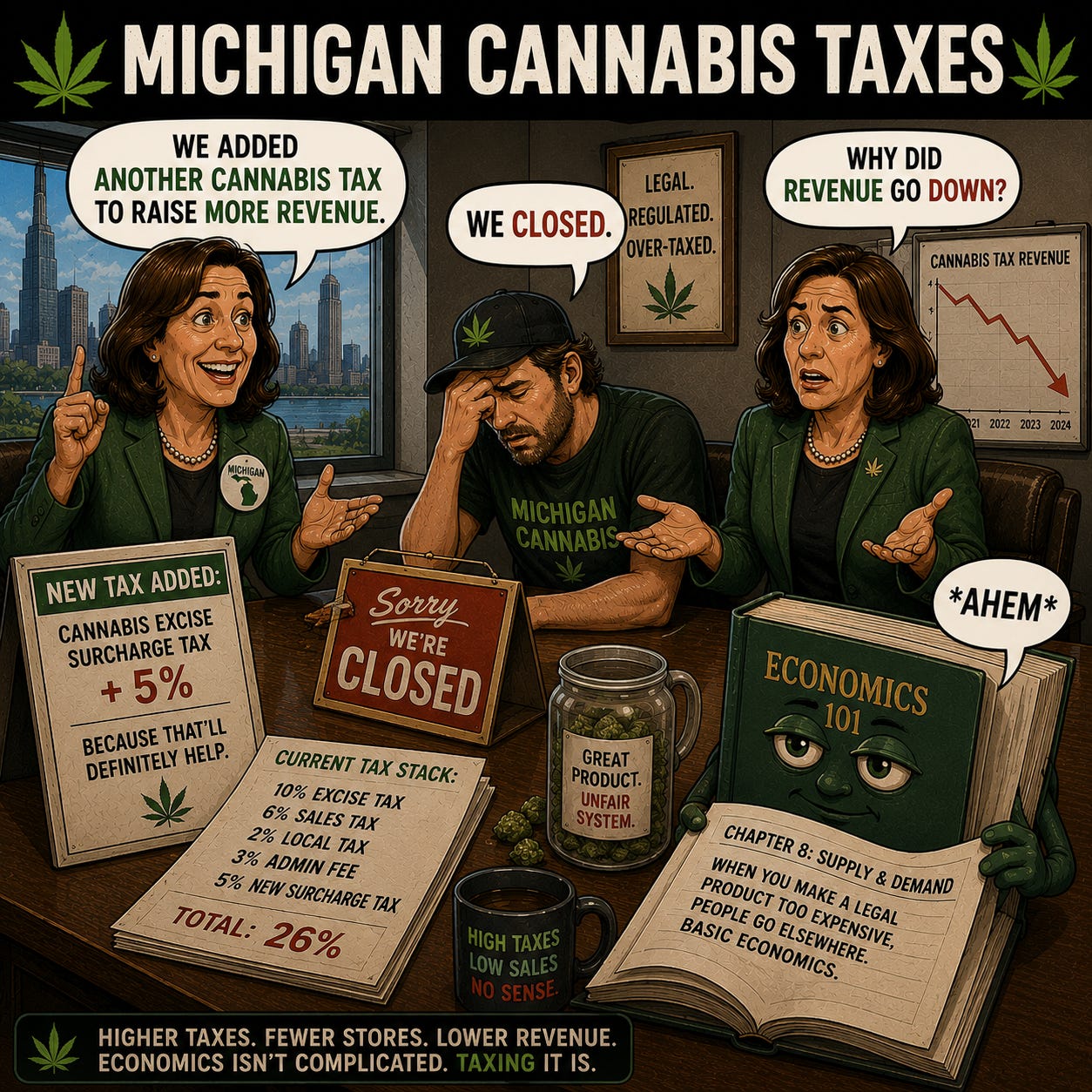
Michigan’s cannabis tax experiment is already drawing a repeal fight. Republican Rep. James DeSana introduced legislation to repeal a recently enacted 24% wholesale marijuana tax, which was meant to fund transportation infrastructure and projected to raise about $420 million. DeSana says revenue is badly underperforming while legal operators get pushed deeper into distress.
The market evidence is hard to ignore. Higher Love Cannabis is suspending operations at five of its nine dispensaries, citing mounting taxes on top of the pressures already hammering Michigan’s market: oversupply, wholesale price compression, thinning margins, a 10% retail excise tax, 6% sales tax, and now the wholesale levy on top.
This is cannabis’s version of the Laffer curve. Governments see a big legal market and assume a higher rate means more revenue. But cannabis consumers have alternatives, and the illicit seller charges no tax at all.
When taxes push legal prices too far above the competing channels, the tax base itself starts shrinking. And businesses react, a dispensary closes, employees lose jobs, wholesale orders vanish, cultivators lose customers, landlords lose tenants, and the state collects zero cannabis tax from that location. This is why cannabis can’t be taxed like a captive industry. Policymakers often treat illicit cannabis as a separate law-enforcement problem, but economically the two are joined, since every dollar added to legal pricing strengthens the illicit seller’s position. The tax also creates financing problems, because lenders underwrite on cash flow, and a margin-compressing levy can push a borrower below debt-service coverage, which hits expansion, equipment, real estate, and hiring. Michigan still sends substantial cannabis revenue to municipalities and tribes, which is exactly why the state should care about operator survival.
The bottom line: The legal market is not a tax ATM. Cannabis taxes only work while the regulated price stays competitive with the unregulated one. Michigan may be discovering governments can tax themselves right out of the revenue they were chasing.
Big Alcohol just publicly asked for the keys to THC drinks.
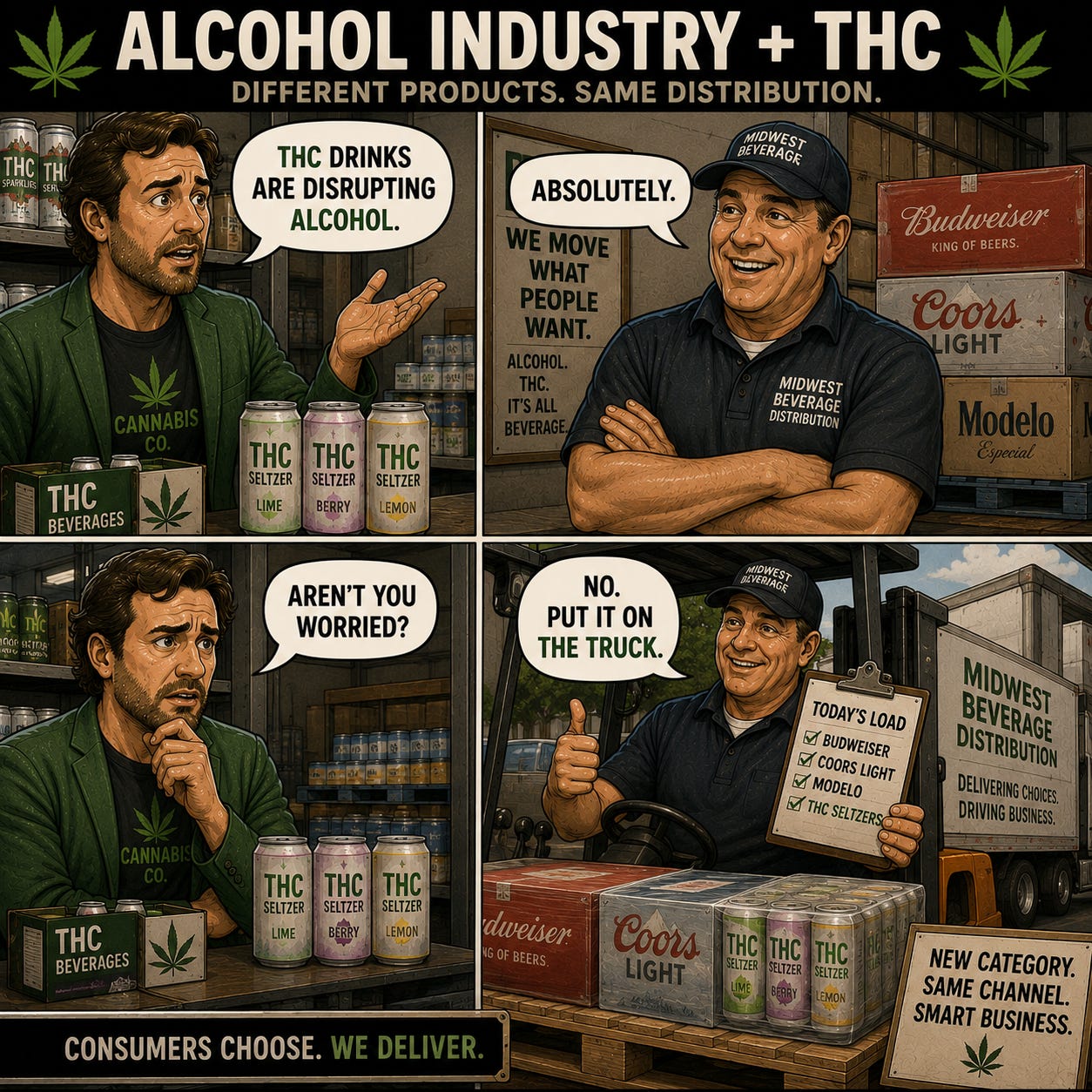
The transformation of THC beverages into a mainstream category just got impossible to ignore. Major alcohol-industry groups are openly backing bipartisan federal legislation to keep low-dose hemp THC drinks legal and regulate them through an alcohol-style structure. The Wine & Spirits Wholesalers of America and the Beverage Alcohol Merchants Coalition endorsed the Beverage Regulatory Parity Act, introduced by Republican Rep. Beth Van Duyne of Texas and Democratic Rep. Greg Landsman of Ohio.
The message from alcohol distributors is a real shift: properly dosed THC beverages belong in a regulated adult-beverage marketplace. Not a gray area. Not necessarily a dispensary. An adult-beverage marketplace. For years the alcohol-cannabis relationship was framed as pure competition, would people drink less if weed were legal, would beer lose younger drinkers. Those questions remain, but big players are recognizing another option.
If the consumer wants THC drinks, sell THC drinks. That’s what established industries do. They absorb the challenger.
The commercial implications are enormous, because alcohol wholesalers already have the warehouses, delivery routes, retailer relationships, sales teams, compliance systems, age-gated outlets, and national distribution knowledge that cannabis beverage startups simply don’t. So mainstreaming THC drinks could ironically shift a big chunk of cannabis economics toward companies that never thought of themselves as cannabis businesses. The competitive map changes overnight, dispensary brand versus cannabis startup becomes cannabis startup versus national beverage distributor, and that’s a very different fight. The retail landscape expands too: liquor stores, bars, restaurants, hospitality groups, a far larger network than dispensaries alone. And it changes consumer behavior, because people don’t make a deliberate trip to a cannabis store, they just grab a different drink from the same fridge where they used to grab a beer. At that point THC beverage isn’t primarily a cannabis product. It’s an occasion product, dinner, a concert, a barbecue, Friday night, watching the game. That’s how alcohol companies think, and cannabis beverage companies should start thinking the same way.
The bottom line: The alcohol industry isn’t waiting to see whether THC drinks compete with it. It’s positioning to own the distribution. The future beverage winner may not have the best strain story. It may be whoever gets onto the same truck as the beer.
Weekend closing
The strangest thing about today’s edition is how little of it is actually about legalization.
The DEA’s HHC fight is about manufacturing. Illinois is about retail channels. Virginia is about inventory write-downs and transition periods. Houston is about municipal budgets. Michigan is about tax elasticity. The alcohol story is about distribution. Those are all ordinary business problems, and that may be the strongest sign yet that cannabis is becoming an ordinary industry.
For years, a cannabis company could explain almost any problem with two words: federal prohibition. That still matters enormously, but it no longer explains everything. A legal company can now fail because its tax structure is irrational. A hemp company can fail because lawmakers gave it 40 days to dump newly noncompliant inventory. A medical program can wither because patients can’t reach convenient stores. A beverage company can lose because a competitor has better distribution. A lender can lose money because a borrower’s product mix becomes illegal even though the business stays licensed. That’s the next stage. Microeconomics matters now, distribution, working capital, tax elasticity, product classification, credit, and politics in increasingly unpredictable ways.
The alcohol story captures it best. A few years ago cannabis and alcohol were treated as enemies. Today major alcohol wholesalers are effectively saying: if consumers want THC beverages, regulate them properly and let us sell them. That’s how industries actually normalize, not when everyone stops resisting, but when existing economic institutions figure out how to make money from them. Illinois is doing a government version of the same thing, consolidating retail instead of maintaining separate systems forever. Virginia shows what badly managed consolidation looks like. Michigan shows that legalization doesn’t hand government unlimited pricing power, because there’s always another competitor, usually an untaxed one. And Houston asks the most basic question of all: if adults keep using cannabis regardless, how many police resources are we willing to spend proving we object?
The next five years of cannabis policy may be less dramatic than the last fifteen. Fewer historic ballot nights, fewer first-dispensary ribbon cuttings. Instead: tax fights, distribution fights, licensing fights, banking fights, product-definition fights, and lawsuits over transition periods. That sounds less exciting. It’s actually progress, because those are the arguments governments have about industries they expect to stick around. Cannabis spent decades fighting for permission to enter the economy. Now everyone’s fighting over the rules of the economy it entered. This time the winners won’t just be the companies that survive prohibition. They’ll be the ones that understand regulation, capital, and distribution better than everybody else.
That’s what this newsletter is for.
What’s the biggest regulatory challenge your operation is facing right now? Hit reply, I read every response and it shapes what I cover next week.
If this was useful, forward it to someone in the cannabis space or hit the restack button on Substack. It’s how this community grows.