
Legal Weed, Illegal Weed, and Nobody Can Tell Which Is Which
Hawaii yanked hemp THC off the shelves this morning, North Carolina says cannabis odor still justifies a search even when it’s lawful, & Massachusetts might actually uninstall legalization.

A Cop Smells Weed. It’s Legal Hemp. He Can Still Search Your Car.
Here’s a genuinely strange question for a Sunday morning: what even is marijuana anymore?
In Hawaii, people were buying hemp-derived THC at regular stores until this week, when the shelves went empty over a testing fight. In North Carolina, hemp is legal and marijuana isn’t, they smell identical, and the state Supreme Court just said that smell can still help justify a police search. Cross a few borders and it gets weirder. Massachusetts voters will decide whether to tear down recreational sales nearly a decade after legalizing. Ohioans can legally buy weed at home but face cheaper product across the Michigan line, which Ohio has made it illegal to bring back. And Texas is banning hemp THC products while candidates argue about whether that just hands the customer to the illicit market.
Welcome to American cannabis policy in 2026. The plant isn’t the confusing part anymore. The rules are. And that’s becoming a serious business problem, because an operator can follow one state’s law and still hit federal risk, a consumer can buy legally on one side of a border and break the law crossing it, and a lender can finance a legal company whose inventory gets banned months later. The industry spent decades demanding legalization. What it needs now might be more important: clarity. Capital can price risk. What it can’t stand is not knowing which rule applies tomorrow. Let me walk you through it.
Hawaii’s hemp crackdown isn’t really hemp vs. marijuana. It’s about parity.
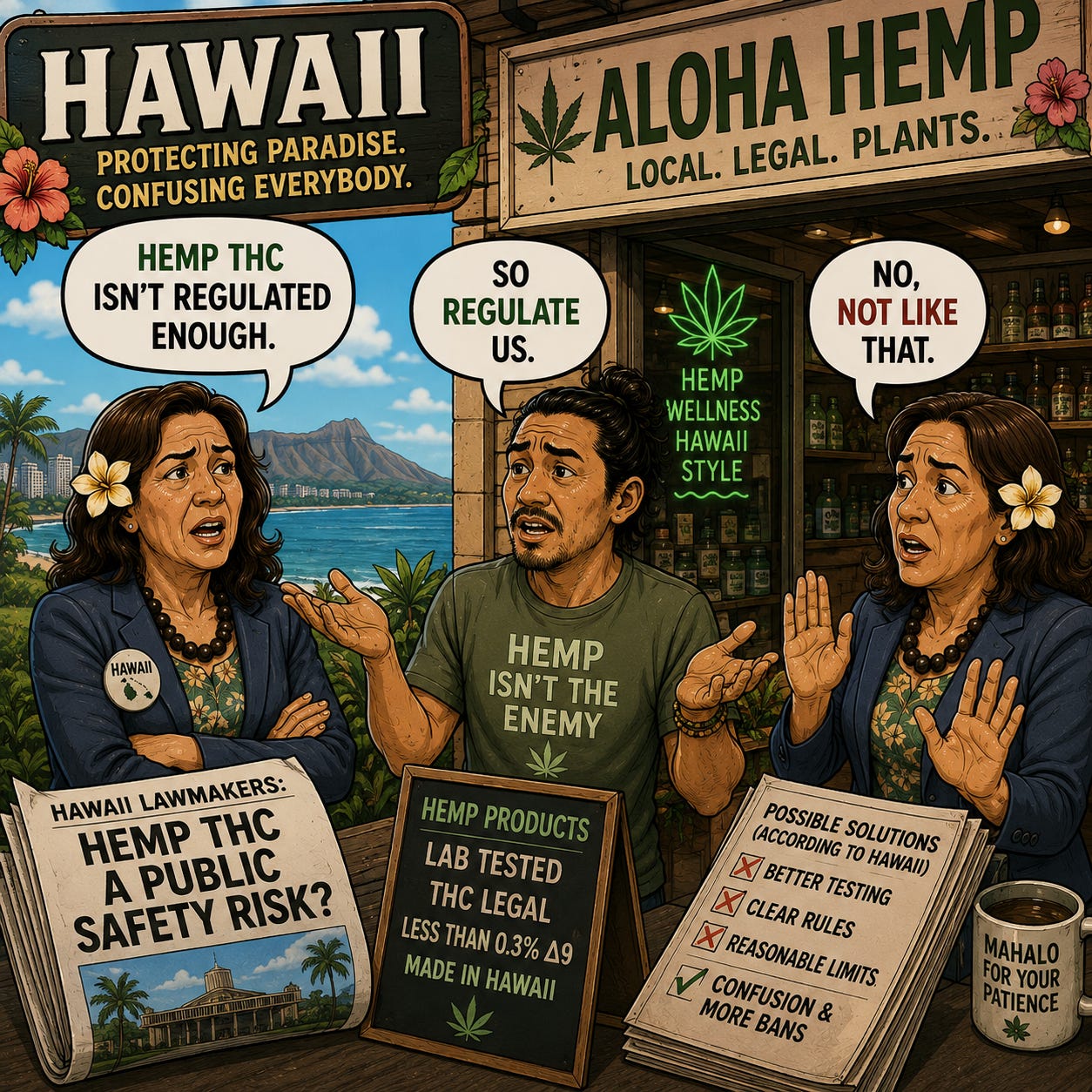
Hawaii officials are defending a crackdown that’s already emptied store shelves. Until recently, adults could walk into ordinary retailers and buy hemp-derived THC without touching the state’s tightly regulated medical marijuana system. Now a lot of that is gone. The Department of Health says it comes down to regulation and testing, since licensed dispensaries operate under heavy requirements while hemp products sold through regular stores didn’t face comparable scrutiny. The industry sees it differently, and a federal lawsuit argues Hawaii is effectively criminalizing hemp that Congress legalized and interfering with interstate commerce.
Underneath the legal fight sits a genuinely interesting commercial question.
Why should two products that produce basically the same effect operate under completely different economic systems? One needs a cannabis license, security, seed-to-sale tracking, and heavy compliance. The other historically sold under a much lighter framework.
That regulatory arbitrage built most of the modern hemp THC industry. Licensed cannabis businesses understandably resent it. Hemp businesses understandably say they built companies around laws the government itself wrote. Hawaii is now trying to close that gap, and here’s where it gets interesting for investors: the future of cannabinoids probably doesn’t belong to either extreme. The current setup, where chemically similar intoxicating products face wildly different rules based on legal definitions, is hard to defend forever. But just deleting one side of the market creates a new problem, because the consumers still exist. Remove hemp THC from regular stores while keeping medical access limited, and some people get medical cards, some stop buying, and some walk straight into the illicit market. That last group is the whole ballgame, because regulation only works when the legal system is attractive enough to actually capture demand. The better long-term answer is probably parity, testing, age limits, labeling, potency standards, real rules, then let the consumer choose. And there’s a wrinkle that makes this even messier: the federal hemp definition is set to tighten later this year anyway, which could make parts of today’s Hawaii lawsuit commercially irrelevant.
The bottom line: Hawaii’s fight isn’t hemp versus marijuana, it’s about regulatory parity. If two intoxicating products chase the same customer, policymakers eventually have to explain why one needs a heavily regulated license and the other doesn’t.
North Carolina legalized something police can’t tell apart from the illegal version by smell.
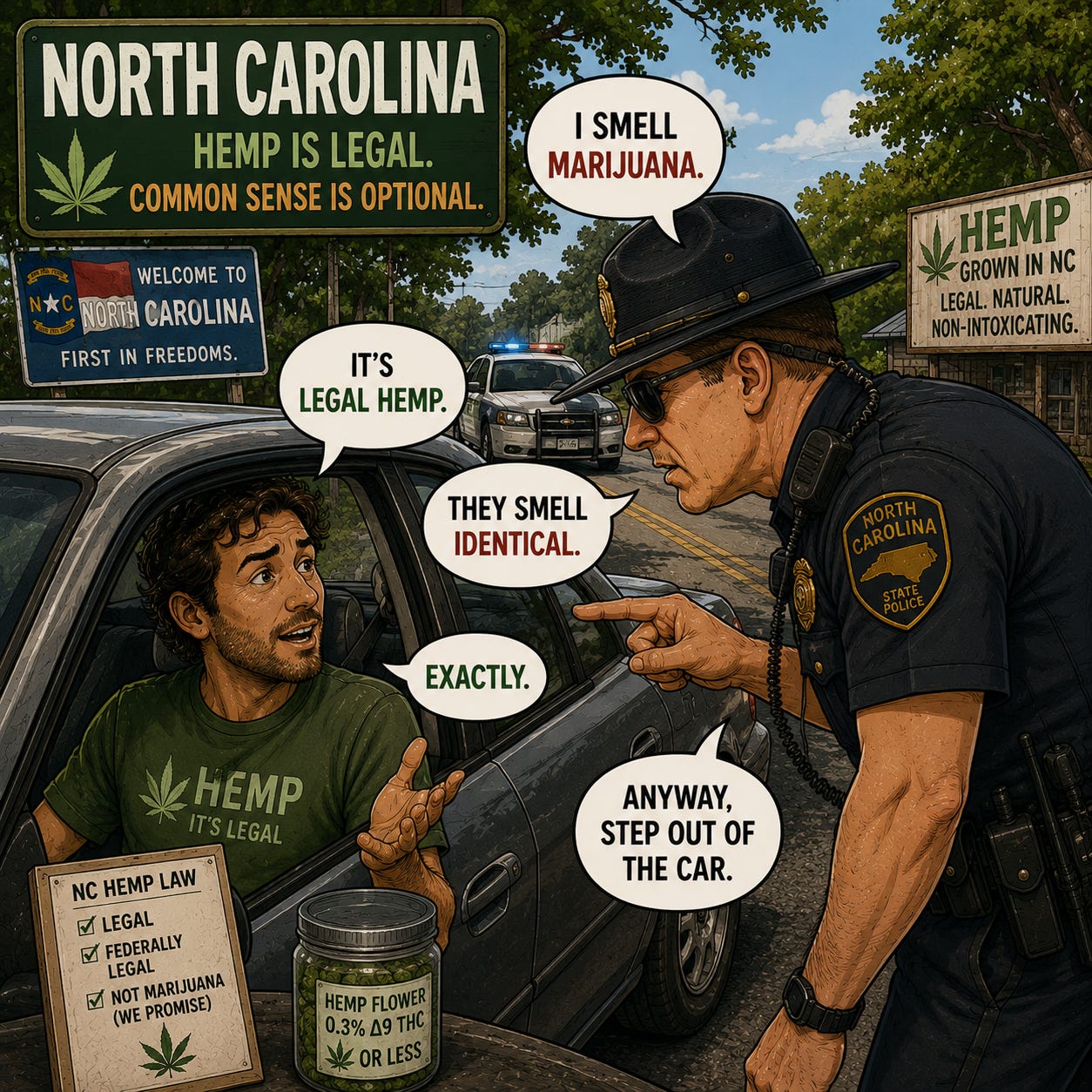
North Carolina has created one of the stranger side effects of hemp legalization: something can smell exactly like contraband without being contraband. The state Supreme Court upheld another conviction from a vehicle search where cannabis odor helped establish probable cause, the third time this year the court has upheld arrests tied to smell. It says odor can remain one factor within the broader “totality of the circumstances.”
The problem is obvious. North Carolina legalized smokable hemp, and legal hemp flower and illegal marijuana look and smell essentially identical. As a defense attorney put it, people doing something perfectly lawful could end up paying for legalization with weaker Fourth Amendment protection.
For decades, the smell of cannabis told an officer one thing: probably illegal marijuana. Legal hemp destroyed that certainty. The smell stayed the same. The inference behind it fell apart.
And policing doctrine hasn’t caught up. The court hasn’t said odor alone permits every search, and earlier cases leaned on extra factors like masking smells and suspicious behavior. But partial legalization creates this weird in-between period where the exact sensory cue associated with a crime is now also produced by a legal product. Think about it this way: if non-alcoholic beer smelled precisely like an illegal substance, would smelling it tell an officer what was actually in the bottle? That’s the cannabis problem. And it ripples further than most lawmakers consider, since legalization quietly changes agriculture, retail, banking, policing, probable-cause doctrine, drug testing, even police dogs trained to alert on marijuana. For hemp retailers, this matters commercially, because customers who buy legal flower may assume that legality shields them from marijuana-related scrutiny, and North Carolina shows that assumption can be dead wrong.
The bottom line: North Carolina legalized something police can’t reliably distinguish by smell from something illegal. That’s not just a cannabis problem, it’s a legal-system design problem. If lawful conduct smells exactly like criminal conduct, you eventually need better evidence than a nose.
Legalization is creating real farm jobs, and now there’s data to prove it.
For years, supporters promised legalization would create jobs. Now researchers are actually measuring them. A Texas Tech analysis found states that legalized marijuana saw roughly a 9% bump in agricultural employment compared to modeled outcomes without legalization, using Bureau of Labor Statistics data from 1990 through 2024. Notably, ag wages didn’t rise significantly alongside the jobs, and researchers found no statistically significant change in overall employment or economy-wide wages.
That nuance is important, and I want to be honest about it. Legalization didn’t magically transform entire state economies. But it did create measurable demand for agricultural labor, and politically that’s gold.
Jobs are much harder to dismiss than projected market valuations. Somebody gets hired. Somebody gets a paycheck. A facility buys equipment, an HVAC contractor gets work, a warehouse gets leased. Cannabis becomes part of an ordinary economic ecosystem.
The broader legal sector supported around 412,500 direct U.S. jobs in early 2026, but this study is more politically interesting precisely because it isolates agriculture, and a lot of states weighing reform have rural communities hunting for new opportunity. Now, cannabis can’t replace every declining farm sector, and nobody should pretend every cultivation license becomes a family farm, since modern cultivation can be highly industrialized. But it’s a new legal crop, and new crops need labor. There’s a real-estate angle too, since cultivation often repurposes warehouses and industrial properties with otherwise limited demand, generating secondary activity around electricity, water, security, and processing. For banks, measurable employment strengthens the case to treat cannabis like other specialized agricultural industries, because a cultivation borrower isn’t mysterious, it has production costs, inventory, labor, wholesale customers, crop risk, and equipment. The regulatory exposure is still unusually high. The underlying economics are increasingly conventional.
The bottom line: Legalization’s economic argument is becoming measurable instead of theoretical. The next challenge is making sure those jobs turn into durable local value, not just bigger cultivation footprints.
Massachusetts is about to test whether legalization can be un-installed.
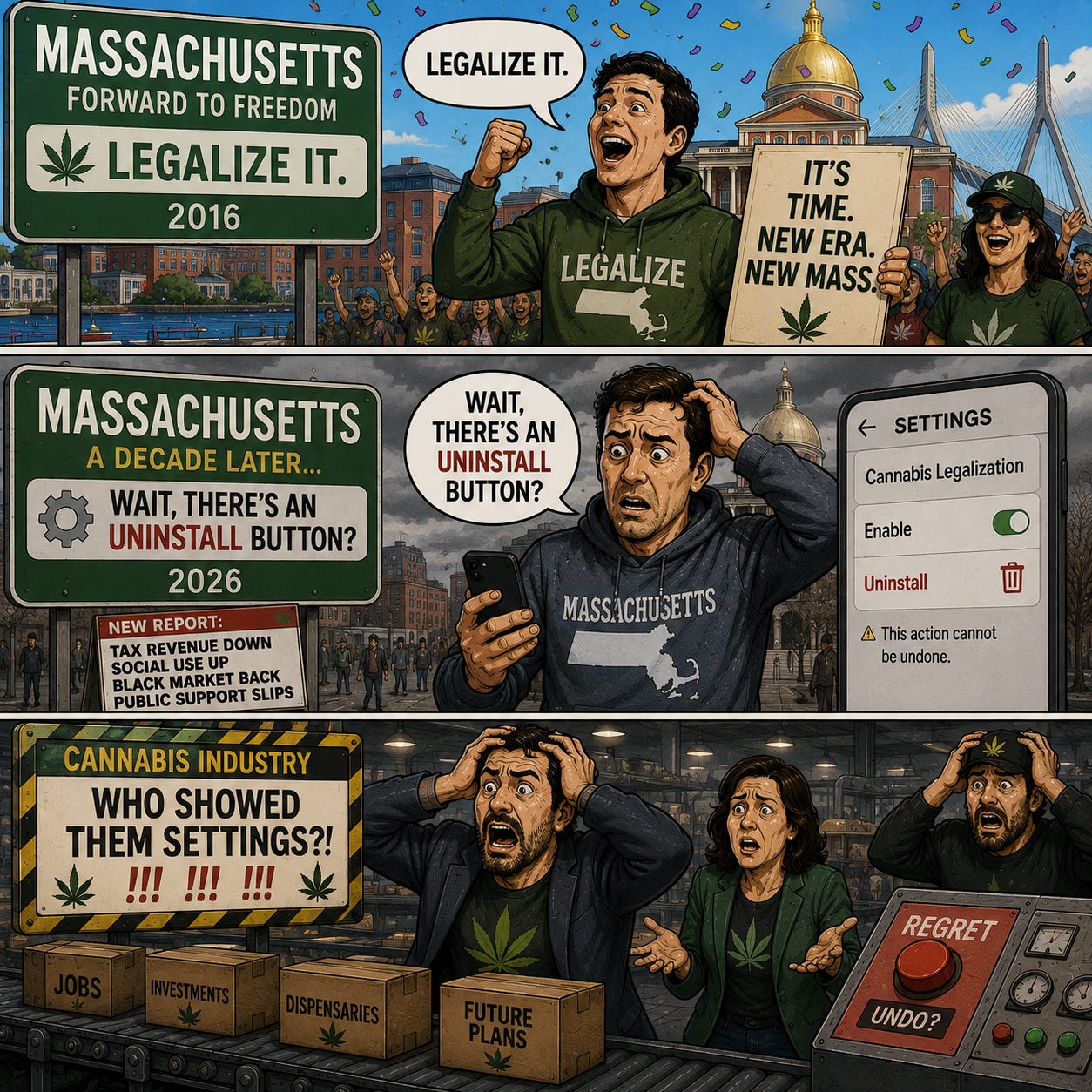
The cannabis movement knows how to campaign for legalization. Massachusetts is about to find out if it knows how to campaign against repeal. A November ballot initiative would dismantle regulated recreational sales and eliminate home cultivation while keeping possession legal and preserving the medical program. The Marijuana Policy Project is warning that a repeal win, or even a nervously close defense, could inspire copycat campaigns in other mature states and spook investors.
That makes Massachusetts a national test. For years, cannabis politics only moved one direction, Colorado, Washington, Oregon, California, and on down the line, and the assumption became that once a state crossed the bridge, nobody walked back. That assumption is now on trial. And the proposed model is genuinely bizarre: adults could still legally possess cannabis, but the regulated system supplying it would vanish.
Where exactly are consumers supposed to get the cannabis they’re legally allowed to possess? Recreational demand doesn’t disappear because storefronts close. It just goes looking for a new supplier, and the obvious candidate is the illicit market.
That actually hands legalization advocates a stronger argument than personal freedom. They can compare two supply systems side by side: one pays taxes, one doesn’t. One tests products, one doesn’t. One can lose its license for selling to minors, the other has no license to lose. One creates documented jobs and can run recalls, the other can’t. But the industry should not get cocky here, because voters may have real frustrations with commercialization, advertising, store density, potency, odor, impaired driving, corporate consolidation. If operators wave those away because “legalization already won,” they risk getting politically disconnected from their own customers and neighbors. Normal industries defend their social license constantly. Banks do it, alcohol does it, casinos do it. Cannabis will have to as well, and its best defense is simply performance: create jobs, pay taxes, keep product away from kids, and make the legal market visibly better than what it replaced.
The bottom line: The legalization movement’s next campaign may be defending legalization itself. Winning a ballot initiative gives an industry permission to operate. It does not grant permanent political immunity.
Texas cannabis politics has become a fight over who gets the customer.
Texas Democratic Senate candidate James Talarico is sharpening the argument that prohibition isn’t just drug policy, it’s market policy. He’s accused Republican opponent and AG Ken Paxton of backing cannabis restrictions in ways that benefit contributors tied to alcohol and tobacco. Paxton didn’t respond to the outlet seeking comment, and I’ll flag clearly that the motive claim is a political allegation, not an established finding. But the economics underneath are worth examining.
Texas restored restrictions on delta-8, delta-10, and other cannabinoids, so products people used to buy from ordinary registered businesses may now fall into Schedule I under state law. And Talarico’s question is simple: what happens to the customer?
The state can eliminate a legal product category. It cannot order consumer demand to disappear. Some switch to compliant products, some quit, some move to alcohol, and some buy illegally. The policy doesn’t erase the market. It reallocates it.
That’s especially relevant now that cannabis and alcohol increasingly compete for the same occasions, THC drinks against beer, edibles against a nightcap. Alcohol companies have noticed, and some are trying to enter THC distribution themselves. What makes Talarico’s framing potentially powerful is that he isn’t asking conservative Texans to embrace cannabis culture. He’s asking why government should decide which industry gets the customer, which is an argument that lands with free-market conservatives, small businesses, libertarians, and voters skeptical of corporate influence. The Paxton allegation still needs evidence to be more than campaign rhetoric, since contributions alone don’t prove corruption. But the deeper shift is real: reform arguments increasingly run on economics, competition, jobs, small business, consumer choice, illicit-market displacement, which may prove far more durable than endlessly debating whether weed is “good” or “bad.” Consumers already settled that individually. The market already exists. Government is just deciding which version gets to operate.
The bottom line: Prohibition doesn’t necessarily eliminate demand. It reallocates revenue. The fight is increasingly about who receives it, the regulated business, an incumbent competitor, or the underground seller.
Ohio legalized cannabis. Michigan still has the better deal.
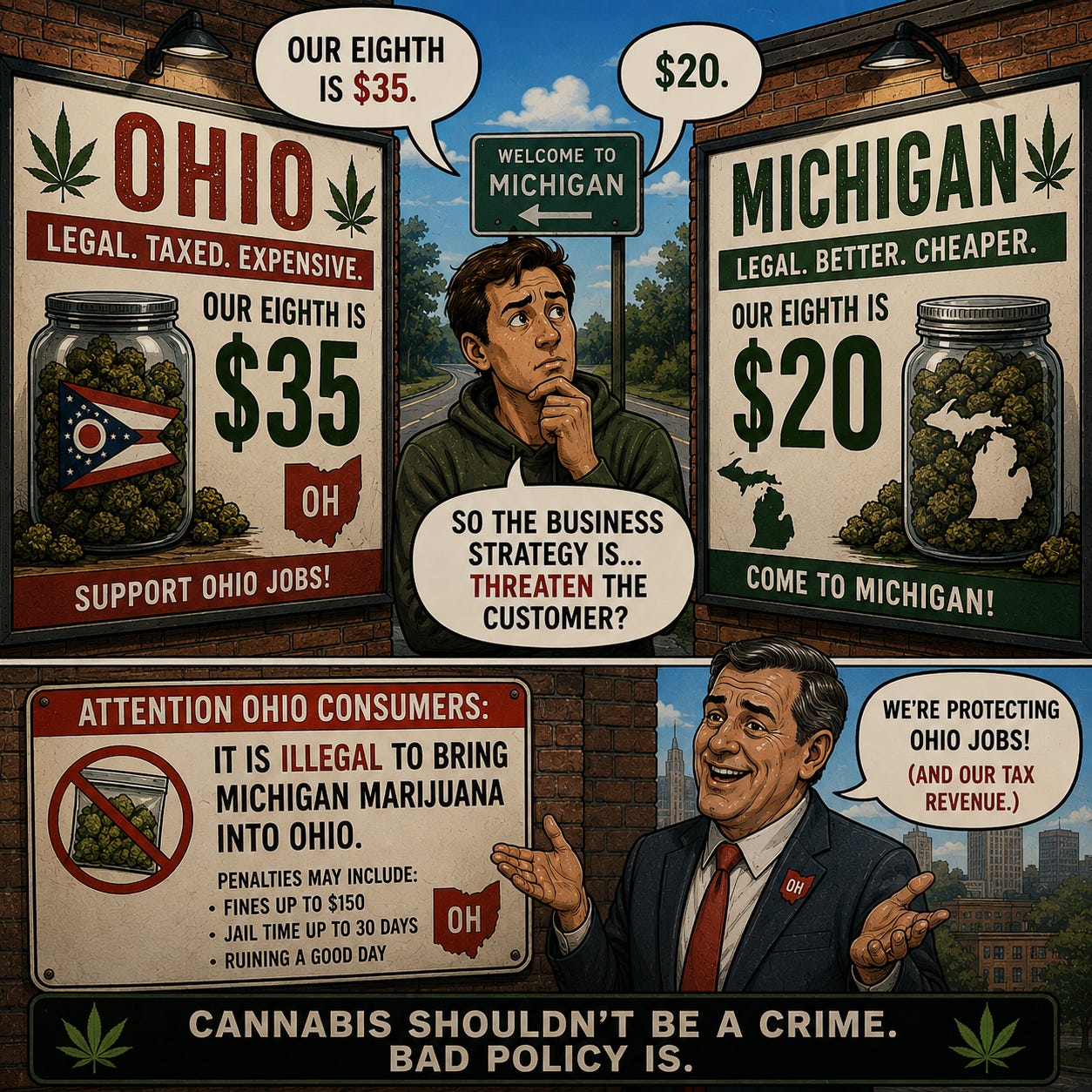
Ohio has discovered one of the less glamorous laws of legalization: consumers compare prices. The median ounce in Ohio runs about $147.35 versus $99 in Michigan, and a median eighth is about $35 in Ohio against $20 in Michigan. That gap matters because Ohio consumers had years to build shopping habits in Michigan before their own market even opened, since Ohio adult-use sales started in August 2024 and Michigan’s began years earlier, giving Michigan a deeper cultivation base and serious price compression. Ohio’s response to cross-border buying was to make it illegal to bring legally purchased out-of-state marijuana back home.
Legally straightforward. Economically fascinating.
Ohio has basically told consumers: cannabis is legal, but buying cheaper legal cannabis somewhere else and driving it home isn’t. The rule does nothing about the underlying price gap. It just threatens the customer for noticing it.
This is one of the lessons legal markets teach over and over. Government keeps modeling demand as if legalization creates a captive customer. It doesn’t. The consumer always has alternatives, another legal state, the illicit market, home cultivation, hemp products, or just buying less. Which means taxes, licensing limits, and supply constraints all shape how much of the market the legal system actually captures. Ohio compounds it with heavy local restrictions, since more than 160 municipalities and townships maintain dispensary moratoriums, and fewer stores means less convenience, which stacked on higher prices hands Michigan an obvious edge near the border. For lenders and investors, the lesson is concrete: don’t evaluate a dispensary just by population within five miles. Look at competing stores, state borders, local bans, pricing, travel patterns, and illicit-market strength. Cannabis retail is becoming ordinary retail, where location and price win and regulatory permission alone doesn’t.
The bottom line: Legalization doesn’t guarantee customer loyalty. People don’t buy regulatory frameworks, they buy products. If another market sells the same thing much cheaper, the border is a speed bump, not a moat.
The DEA’s HHC fight shows why “hemp-derived” is losing its magic.
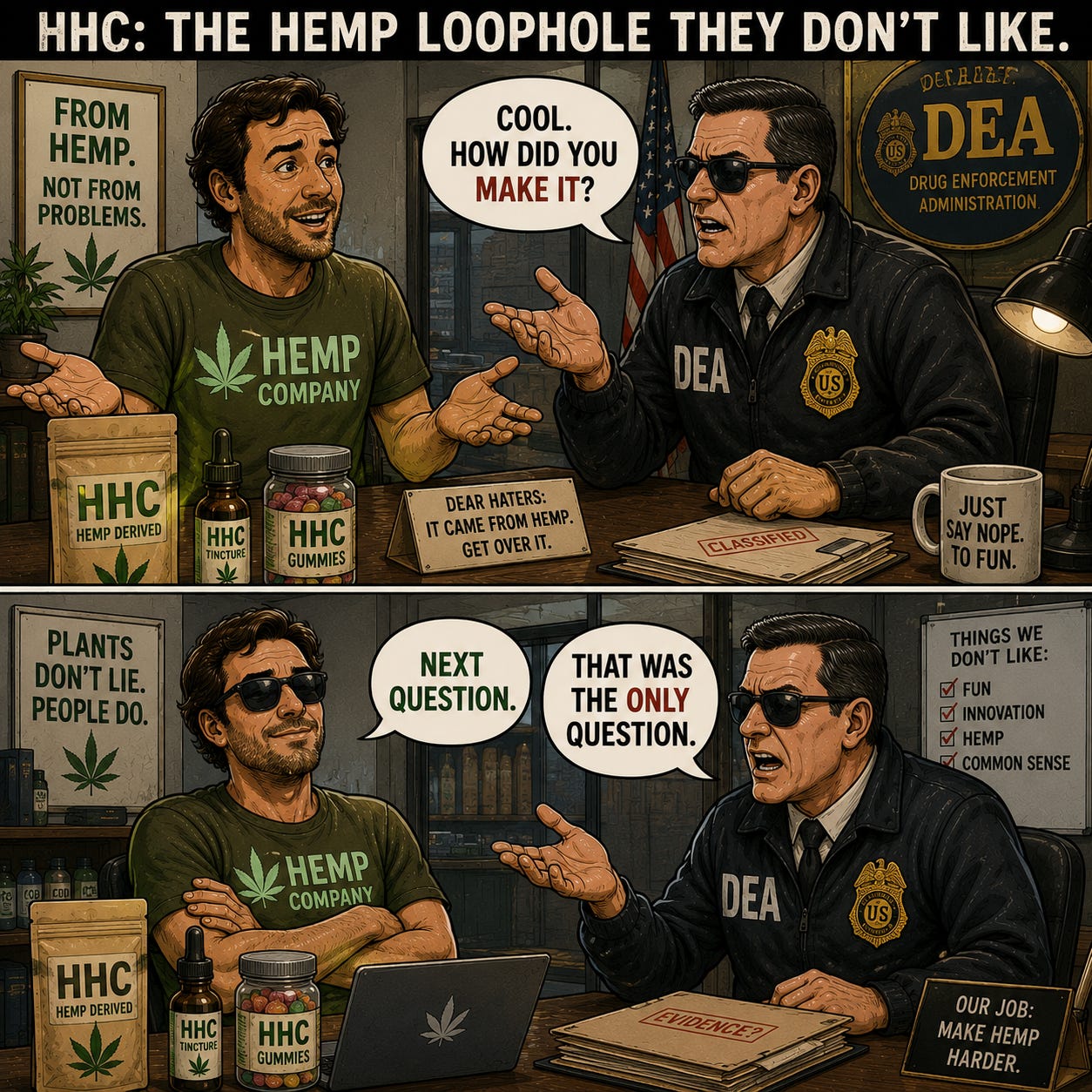
The DEA is defending its position that synthetically produced HHC is already Schedule I. It gave the compound its own tracking code earlier this year, hemp businesses challenged it, and the agency’s response is essentially that the companies are attacking an administrative change that didn’t alter the drug’s legal status, since HHC was already Schedule I when made synthetically and the code just makes tracking easier.
Sounds like an obscure procedural spat. It may define the next generation of cannabinoid regulation. For years the hemp industry’s most powerful phrase was “derived from hemp.” The 2018 Farm Bill made hemp lawful, and entrepreneurs figured out they could extract legal CBD and chemically convert it into other intoxicating cannabinoids. The source was hemp, but the finished molecule could behave completely differently.
The DEA is increasingly saying source isn’t the only question. Process matters. Was it naturally extracted? Was another cannabinoid converted into it? Was it synthesized? That single distinction could separate the legal cannabinoids from the illegal ones.
For banks, this rewrites due diligence entirely. “Does the customer sell hemp?” stops being a useful compliance question. The institution may need to understand individual SKUs, cannabinoid composition, manufacturing method, lab testing, state legality, federal interpretation, and distribution, which is closer to pharmaceutical or specialty-chemical diligence than ordinary agricultural lending. It’s also a survival test for the companies themselves. Businesses built around ambiguity thrived after 2018, but ambiguity is hard to finance, hard to insure, hard to scale, and eventually regulators close it. The strongest players will be the ones that can operate once lawmakers write explicit rules, which probably means fewer exotic converted cannabinoids and more standardized products, national testing standards, age limits, and clear lines between natural and synthetic compounds. That shrinks parts of today’s market. It could also make the surviving market far more bankable.
The bottom line: The next regulatory question isn’t “did it come from hemp?” It’s “how did you make it?” That distinction could wipe out some business models while making others a lot more legitimate.
Texas critics warn prohibition could make the hemp market less safe, not safer.
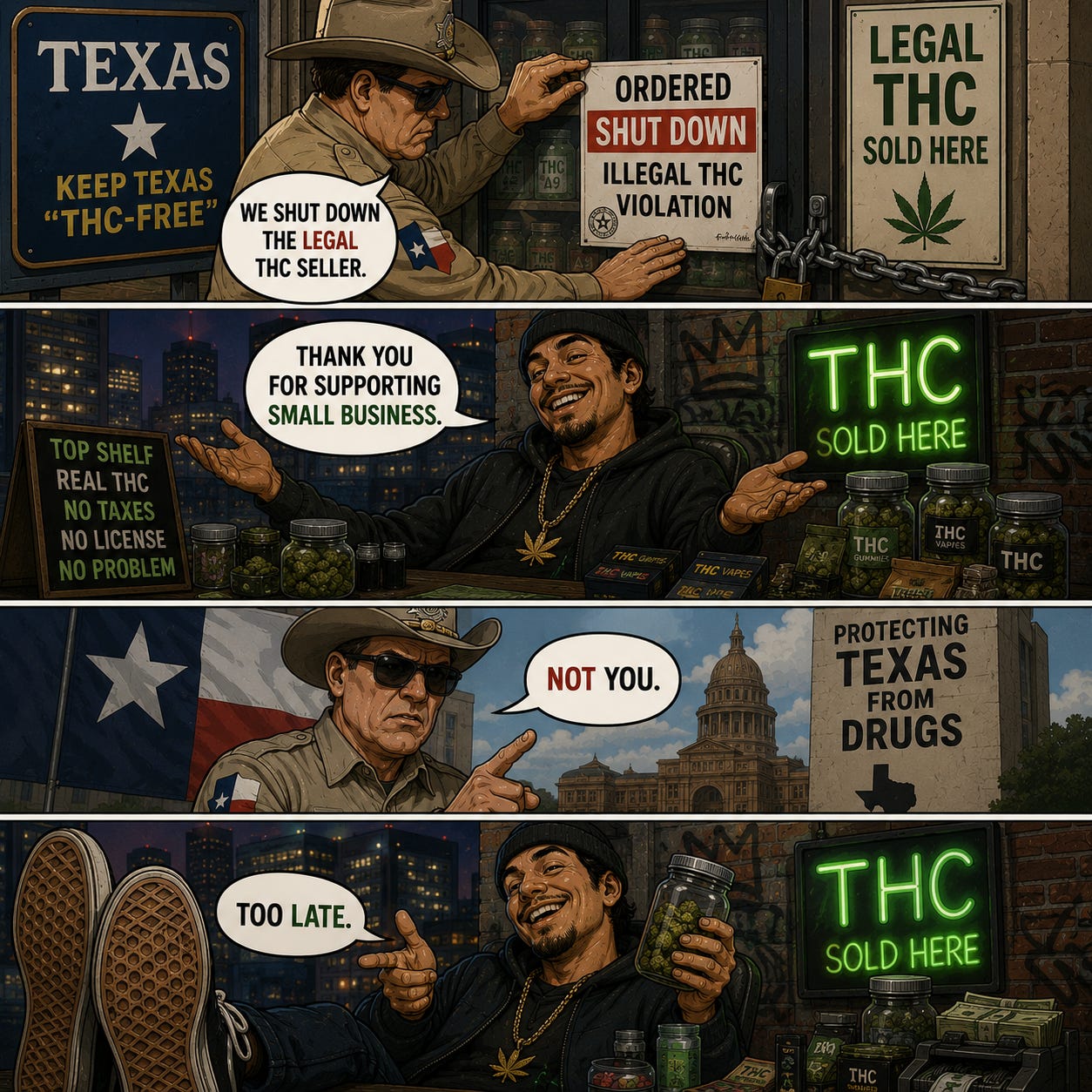
A Marijuana Moment op-ed from criminal-justice advocate Michael A. Davis makes a provocative case about Texas’s crackdown: the state may be removing the businesses it can regulate while leaving the ones it can’t. Davis doesn’t claim the hemp market was perfect, and he acknowledges real concerns about youth-oriented packaging, inconsistent testing, and questionable products. His point is that those problems called for stronger regulation, not a return to prohibition.
Texas already had pieces of a regulatory framework, age restrictions, ID requirements, testing, labeling, inspections, all of which could theoretically have been strengthened. Instead the state restored restrictions that pulled products out of ordinary legal commerce. And the business logic here is worth sitting with regardless of how you feel about hemp.
A licensed retailer has assets the government can threaten, a license, a lease, a bank account, inventory, a reputation. An illicit seller already operates outside all of it. You can’t revoke a license the dealer never had.
If a licensed store sells to minors, regulators can penalize it. If testing fails, inventory gets recalled. If labels are fraudulent, the state knows exactly where to find the company. None of that leverage exists over the underground seller. This doesn’t mean every intoxicating cannabinoid belongs on a convenience-store shelf, and some compounds may deserve much stricter control. But risk-based regulation and prohibition are different strategies, a 5mg beverage may need one framework, a converted high-potency cannabinoid another, a CBD tincture another. The catch is administrative complexity, because real regulation means government has to understand the products, test them, classify them, license sellers, and monitor compliance. Prohibition is easier, you just say no. The open question is whether easier produces better outcomes, and Texas is about to generate real evidence. If consumption falls sharply, the crackdown’s supporters have a case. If consumers just migrate to illicit marijuana or underground cannabinoids, critics will argue the policy moved commerce without reducing demand.
The bottom line: Texas is running a live experiment, does prohibition eliminate a cannabinoid market, or just remove the regulated seller from it? The answer will matter far beyond Texas.
Sunday closing
Twenty years ago, cannabis law was harsh but simple. Marijuana was illegal, full stop.
Today, a product can be legal because it came from hemp, unless the manufacturing process changes the answer. A consumer can legally buy cannabis, unless they bought it in the wrong legal state. A substance can smell exactly like marijuana but actually be lawful hemp, and police can still use that smell to justify a search. A state can spend a decade building a legal industry, and then voters can be asked whether they want to tear it down. That’s not just legal complexity. It’s economic friction, and every unclear rule carries a cost, lawyers, compliance officers, inventory write-offs, higher financing costs, payment-processing headaches, insurance premiums, delayed investment, and businesses simply deciding the uncertainty isn’t worth it.
That should worry regulators, and here’s the key point: good regulation doesn’t mean weak regulation. Cannabis can absolutely have strict testing, age controls, potency standards, packaging rules, advertising limits, taxes, and serious penalties for violators. But the rules have to be understandable, reasonably durable, and economically sensible for similar products. Hawaii captures the whole challenge, officials are right to ask why consumers should buy untested intoxicating products, and hemp businesses are equally right to ask why the government let an industry develop and then changed the rules after everyone invested. Both problems have the same solution: regulate the product. North Carolina shows a different failure, legalizing hemp without updating the assumptions around cannabis odor, so lawful conduct stays suspicious because the legal system hasn’t caught up. Ohio shows the cost of ignoring economics, because you can legalize, license, and ban interstate transport, but if Michigan sells the same thing cheaper, consumers notice. Markets always notice.
And Massachusetts may be the biggest warning of all: legalization isn’t permanent just because businesses built stores around it. An industry has to keep earning its political legitimacy, create jobs, protect consumers, pay taxes, employ locals, operate responsibly, and give voters a reason to prefer regulated commerce over the alternative. The agricultural jobs study hands the industry exactly that kind of evidence, proof that cannabis isn’t just generating sales but measurable economic activity. Because cannabis doesn’t have to prove people want it anymore. That was settled long ago. The real challenge now is building rules that consumers can understand, businesses can survive, and banks can actually underwrite. America already built a cannabis economy. Now it has to decide whether it wants that economy regulated, or just confused.
That’s what this newsletter is for.
What’s the biggest regulatory challenge your operation is facing right now? Hit reply, I read every response and it shapes what I cover next week.
If this was useful, forward it to someone in the cannabis space or hit the restack button on Substack. It’s how this community grows.