
The Government Just Published a Report on Weed Scales
Plus a 1994 conviction becomes a gun-rights case, Texas threatens to torch its hemp market, and Virginia makes patients choose between medicine and housing.

The Fine Print Is Becoming the Fight
Cannabis reform isn’t about legalization anymore. It’s about rights, housing, hemp, and who quietly gets priced out of the legal future.
Here’s the thing nobody warns you about when you win: the hard part starts after.
“Legalize it” was the easy sell. Now comes the messy question of what happens next, and it turns out that question doesn’t get answered in one big federal moment. It gets answered in a hundred small decisions that most people never notice. That’s exactly what this week looked like.
Texas is threatening to burn down its own hemp market. A guy’s marijuana conviction from 1994 is somehow a Second Amendment case now. Virginia patients are being told to pick between their medicine and a roof over their heads. And the federal government, I promise I’m not making this up, published a report about scales.
None of it is flashy. All of it matters. Let me walk you through it.
Texas is about to learn a hard lesson about banning things people already buy.
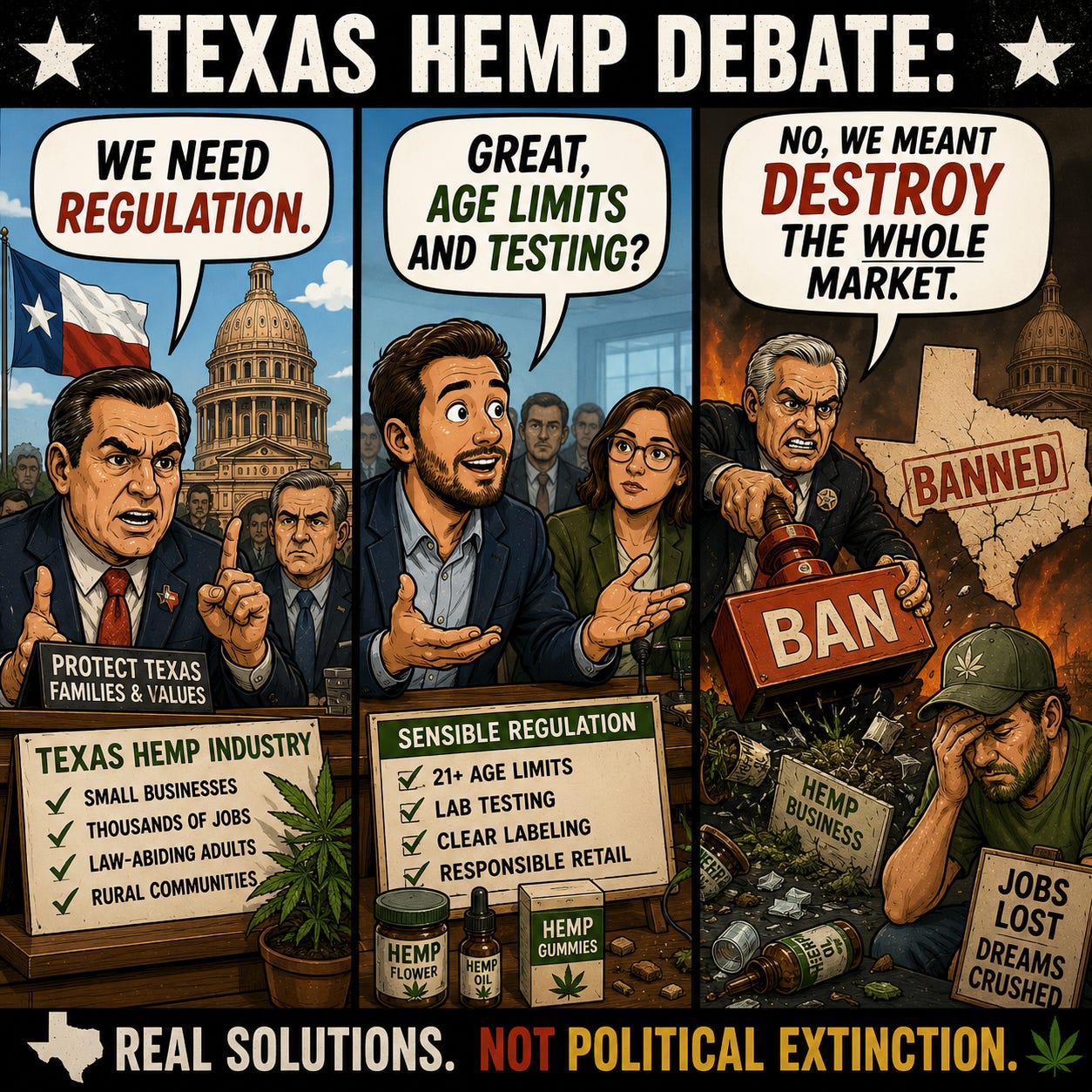
State Senator Charles Perry says he’s coming back to ban consumable hemp THC products. This follows a committee hearing that was basically a parade of warnings about youth use, mental health, and poison control calls. Perry talked up licensing fees high enough to push businesses out, and said he’s hit his breaking point with the hemp industry.
So here’s the situation Texas has gotten itself into. It has a huge hemp market and no legal weed. When the state didn’t build an adult-use system, hemp THC just quietly filled the gap, because that’s what happens when there’s demand and no legal way to meet it. Now lawmakers want to slam that gap shut without putting anything in its place.
You can probably guess how that goes. People who want THC don’t stop wanting it because a bill passed. They just buy it somewhere with no testing, no labels, and nobody checking IDs. Texas actually did the smart thing earlier this year with packaging rules, testing, and age limits. That’s regulation, and it works. What Perry’s describing isn’t tougher regulation, it’s demolition. And the market doesn’t disappear when you demolish the legal version of it. It just goes underground.
The bottom line: Texas isn’t really deciding how to regulate hemp. It’s deciding whether it can wish away a market that already exists, and that bet loses almost every time.
A weed conviction from 1994 just became a constitutional problem
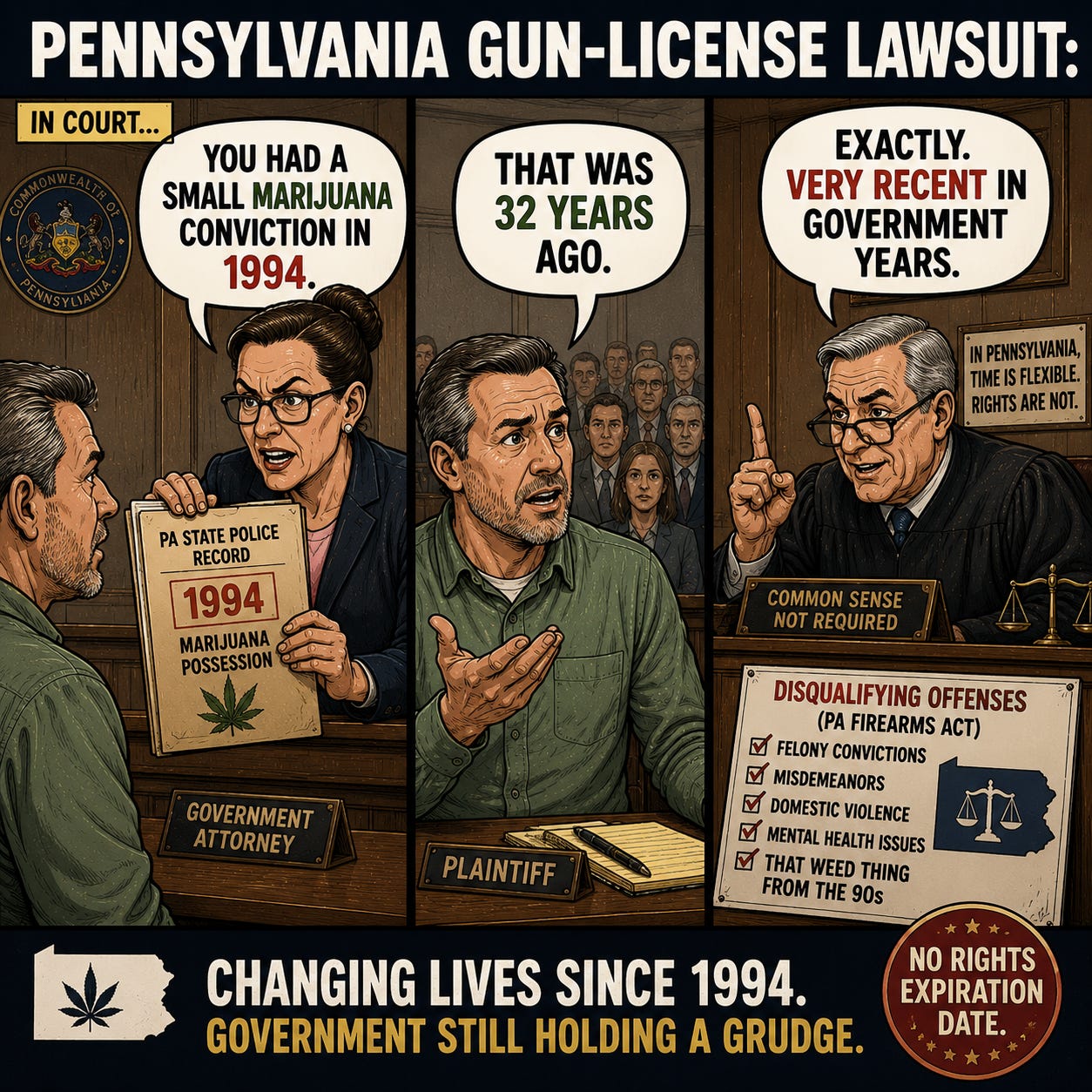
An Air Force veteran is suing Pennsylvania over a law that permanently blocks anyone with a past drug conviction, including ancient marijuana possession, from getting a license to carry a firearm. His conviction was for a small amount of cannabis in 1994. No drug use since. No other record. Still permanently locked out.
The lawsuit points straight at the Supreme Court’s recent cannabis gun-rights ruling, arguing there’s just no historical basis for stripping someone’s gun rights forever over a nonviolent weed offense from three decades ago.
This is the part of reform people forget about. We spent so long arguing about whether cannabis should be legal that we skipped past a quieter question: what do we do about everyone still carrying the weight of old convictions? This guy lived cleanly for thirty-two years and still gets treated like a risk, all while the federal government is busy rescheduling the exact substance he was convicted for. That contradiction can’t hold forever, and cases like this are how it starts to fall apart. Legalization was step one. Undoing the damage from the prohibition years is step two, and we’re only just getting there.
The bottom line: Reform is moving past legalization into cleaning up old records, and those decades-old convictions are getting really hard to justify.
Virginia is making patients choose between their medicine and their housing.
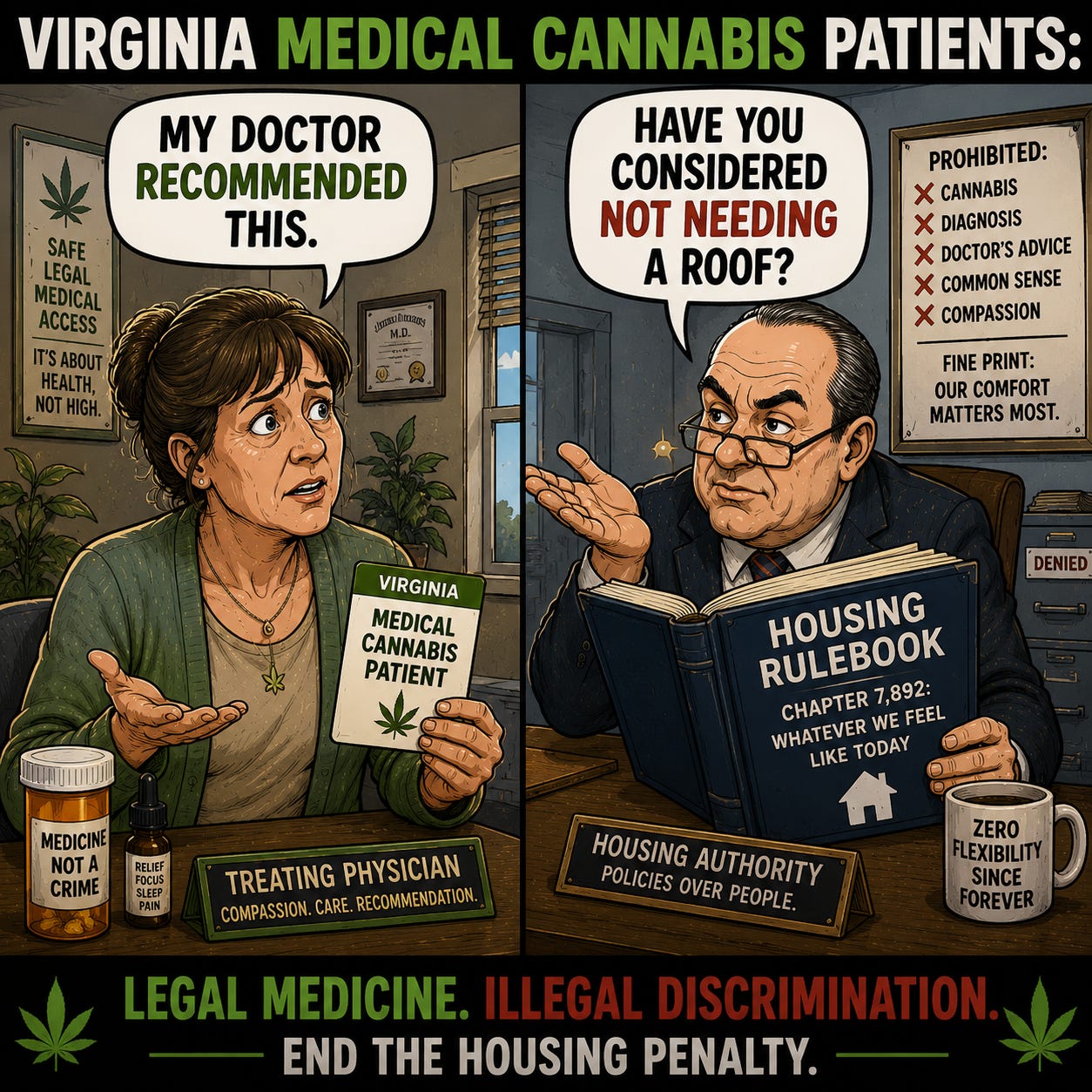
There’s a sharp op-ed out arguing that Virginia’s state-certified recovery residences are being forced to ban all cannabis, medical included, under certification rules tied to Senate Bill 270. So if you’re a patient living in recovery housing, your options are to stop using medicine your doctor recommended, or risk losing the stable housing you need.
Think about how backwards that is. Virginia already protects medical cannabis patients from discrimination in hospitals, nursing homes, and schools. But recovery housing somehow gets carved out, so the same person with PTSD or chronic pain can legally use their medicine in one place and get kicked out for it in another. There’s no logic to it. It’s just an old bias that legalization didn’t automatically sweep away.
The op-ed floats an interesting legal angle too, that since medical cannabis is Schedule III now, denying someone housing over a doctor-approved, non-smoked medication might run afoul of fair housing and disability law. We’ll see if that holds up. But honestly, you don’t need the legal theory to see the problem. Medicine that can cost you your home isn’t really accessible. Legalization takes away the criminal penalty, sure. It doesn’t automatically fix all the other rules, housing, jobs, insurance, that still quietly treat cannabis like it’s disqualifying.
The bottom line: If using your medicine can cost you your housing, you don’t actually have access. Half-finished reform leaves these traps lying around everywhere.
Illinois just quietly showed everyone what a grown-up cannabis market looks like.
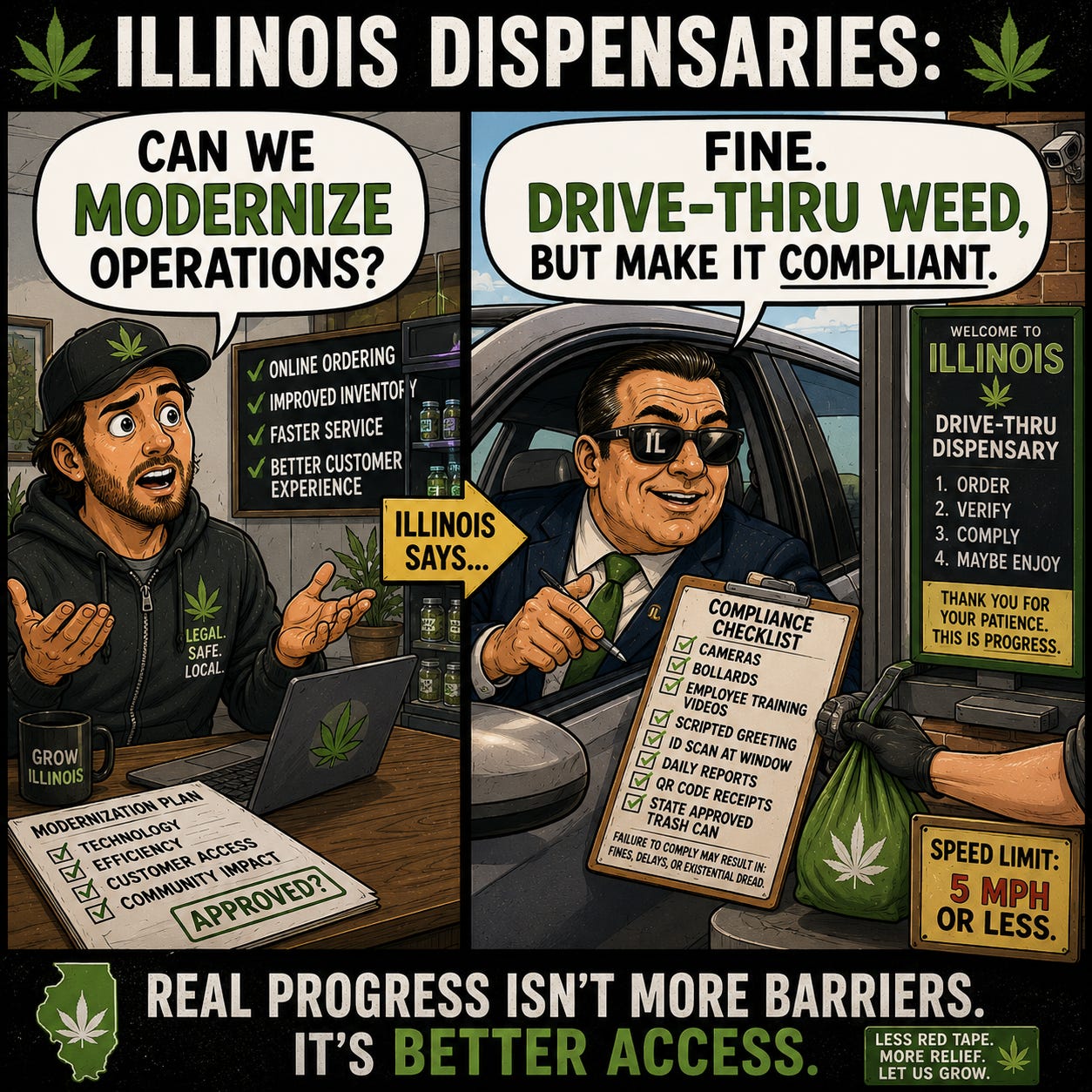
Illinois regulators put out guidance on a new omnibus law, and the list of changes is telling: doubled possession limits, drive-thru and curbside pickup, longer hours with local sign-off, permission to hire their own security instead of being forced to use outside firms, and shorter surveillance retention.
Looks like housekeeping. It’s actually a big deal.
What you’re watching is Illinois graduate from “is this legal” to “how do we make this run well.” For years, operators dealt with rules that basically assumed they were up to something, mandatory third-party security, three months of surveillance footage, tight hours. Illinois is loosening that grip while keeping the market regulated, which is a real vote of confidence. Everyone’s going to talk about drive-thru weed, and fine, that’s fun. But the security changes are the actual story. Letting dispensaries run their own security and cut footage retention from 90 days to 60 says regulators have stopped treating them like suspects. That shift in attitude matters way more than the convenience stuff.
The bottom line: Illinois is moving from legalization to just making the market work better. That quiet move from suspicion to trust is what maturity really looks like.
The most boring story this week is secretly one of the most important.
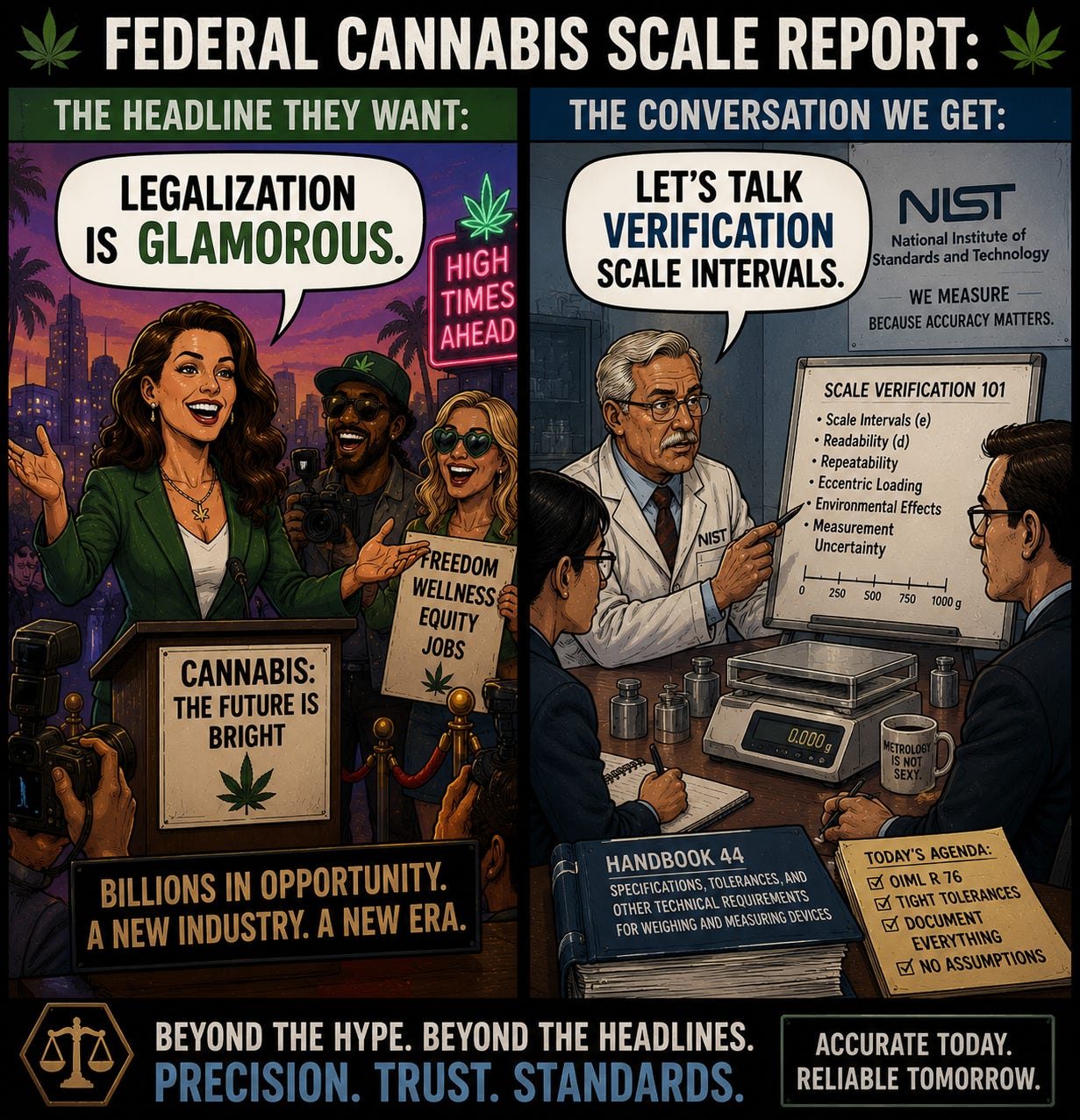
The National Institute of Standards and Technology put out a report to help states set standards for the scales used to weigh marijuana. Accuracy classes, verification intervals, minimum loads, all of it. Cannabis is tricky, the report notes, because it’s expensive, moisture-sensitive, and sold in tiny amounts.
I know. Scales. Hang with me for a second, because this matters more than it sounds.
Every legit market runs on trust. You need to know you got what you paid for, regulators need consistency, and businesses need rules that are precise without being ridiculous. Weights and measures are the foundation of all of it. It’s the same reason it never crosses your mind that the gas pump might be shorting you. Somebody set that standard a long time ago and now you just trust it.
The fact that federal agencies are now fussing over scale intervals for cannabis is actually a sign the industry made it. The early years were all about the giant philosophical fights. This is what comes after, the unglamorous plumbing that turns a gray market into a real one. The boring stuff isn’t a distraction from legitimacy. It’s how legitimacy gets built.
The bottom line: Normalization now includes the boring machinery of commerce, and that boring machinery is exactly what makes people trust a regulated market.
THC drinks are quietly stealing customers from alcohol.
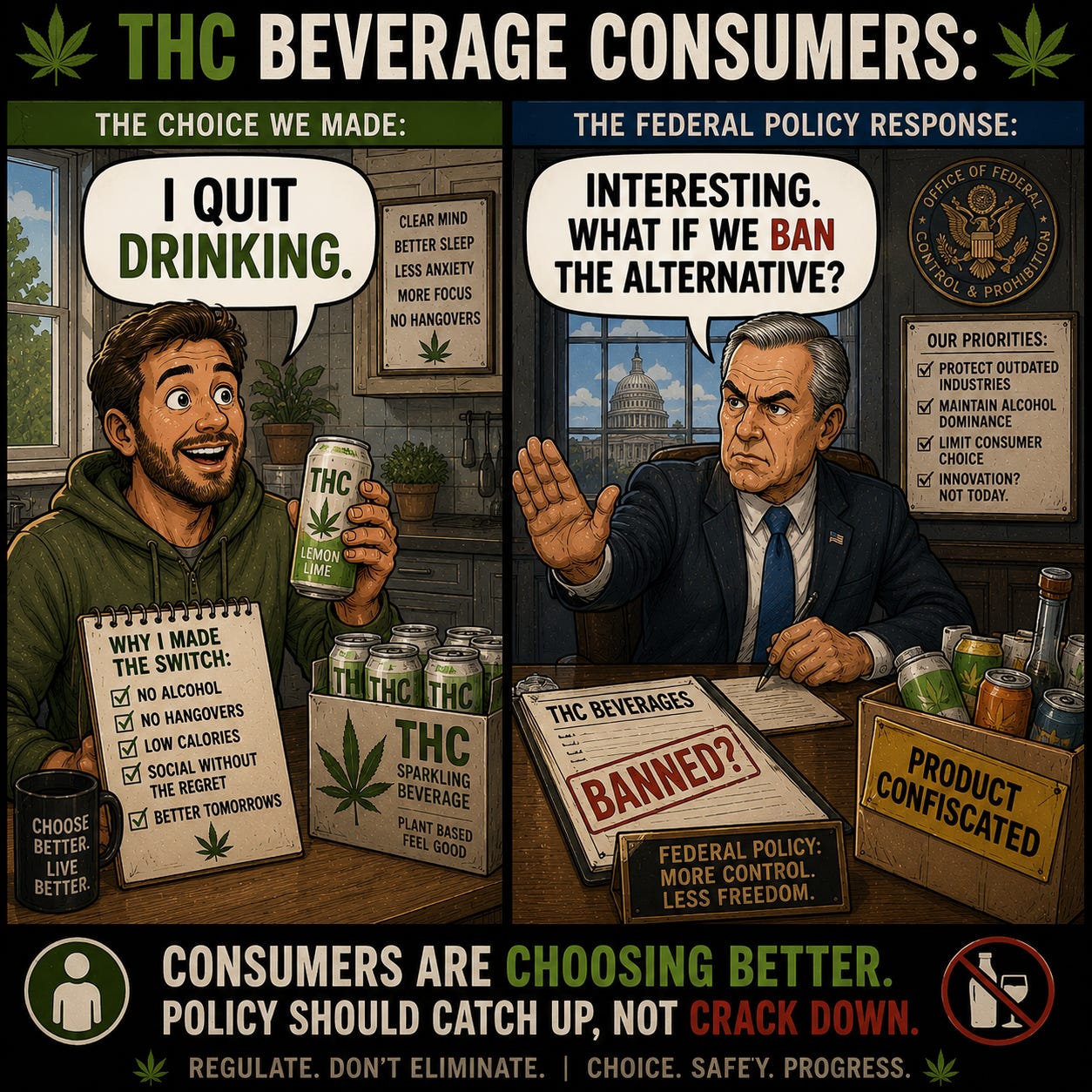
A new Crescent Canna survey found that more than three out of four THC beverage drinkers cut back on alcohol after making the switch. 37% drink much less, and 21% quit booze entirely. Almost half say the drinks are part of a regular wellness routine, and 60% point to the lack of a hangover as the big draw.
I’ve said before that hemp beverages are the most interesting growth story in cannabis, and this is why. These drinks aren’t just another product on the shelf. They’re a straight-up alcohol replacement, and that’s a much bigger deal. They’re social, easy to dose, and familiar to people who would never smoke or walk into a dispensary. That’s the crowd cannabis has always had trouble reaching, and beverages get there without even trying.
But there’s a catch hanging over the whole thing, and it’s that November hemp cliff. The survey found people already know restrictions might be coming, and some are stocking up. If hemp THC drinks get banned without a legal path forward, a bunch of these folks go right back to alcohol. Really sit with that for a second. Here’s a product measurably helping adults drink less, and clumsy policy could shove them back toward the thing that’s worse for them. Whoever’s writing these hemp rules might be badly missing what this category has quietly become.
The bottom line: THC drinks have gone from novelty to genuine alcohol alternative, and a sloppy hemp ban could hand all those customers straight back to booze.
Oregon is about to price its own psilocybin experiment out of business.
Oregon regulators want to jack up fees across the psilocybin industry, doubling annual manufacturer and service-center licenses from $10,000 to $20,000. The program pays for itself through fees instead of tax dollars, and the money isn’t keeping up with costs.
The budget math is real. The fallout could be brutal.
This is the clearest warning in this whole edition, and it points right at cannabis. Oregon built the first legal psilocybin program in the country as a mental health breakthrough. But sessions already run $850 to $3,000, so access has skewed heavily toward people with money. Now higher fees mean more closures and even steeper prices. And here’s the kicker: about half the licensed service centers have already expired or been handed back. The thing was wobbling before anyone floated a fee hike.
That’s not just businesses struggling. It’s an access problem, and it’s the exact trap cannabis keeps flirting with. A market can technically be legal while fees and taxes and compliance costs make it impossible for anyone but the deep-pocketed to actually play. Legal on paper, out of reach in practice. Oregon’s running that experiment live right now, and it’s not looking good.
The bottom line: Oregon might end up proving that legal-but-unaffordable is just prohibition wearing a nicer suit. Access nobody can actually use isn’t really access.
Virginia’s writing the rulebook now, and the rulebook is where everything gets decided.
The Virginia Cannabis Control Authority opened a public survey, running through July 21, to collect input as it drafts adult-use rules on licensing, fees, security, advertising, testing, packaging, enforcement, and the rest.
This is where the real work of legalization actually happens, and it’s the part almost nobody pays attention to. Passing the law was the headline moment. But a law just says a market is allowed. It doesn’t build one. Every question that decides who actually wins and loses gets settled right here, in the rulemaking. Who gets licenses. How fees are set. Whether the testing rules are realistic. Whether a small operator or an equity applicant can even afford to get in the door.
Remember that $10 million conversion fee for medical operators from Virginia’s legalization deal? That’s precisely the kind of quiet detail that tilts a whole market toward the big multi-state players and away from local businesses. The survey’s genuinely a good move, and asking patients, small operators, and health experts what they think is the right instinct. But asking only counts if they actually listen. The real test isn’t whether Virginia sends out a survey. It’s whether it pays attention before the rules lock in, because once they harden, they’re a nightmare to undo.
The bottom line: Virginia is moving from headline to rulebook, and it’s the rulebook, not the law, that decides who really benefits.
Final thought
Cannabis reform has stopped waiting on one big breakthrough, and this week is the proof that it’s not coming.
Instead the industry is getting built, and sometimes broken, through a thousand smaller calls. Who keeps their housing. Who can carry a gun. Who’s allowed to sell hemp. Who can afford psilocybin therapy. How dispensaries run. How product gets weighed. Who writes the rules for the next market.
None of it fits on a protest sign. All of it decides who actually makes it in the legal industry that reform created.
This is the fine print era. And in cannabis, the fine print is the fight now.
That’s what this newsletter is for.
What’s the biggest regulatory challenge your operation is facing right now? Hit reply, I read every response and it shapes what I cover next week.
If this was useful, forward it to someone in the cannabis space or hit the restack button on Substack. It’s how this community grows.